
Disclosure: As an Amazon Associate, Veranoz earns from qualifying purchases. We may earn a commission at no extra cost to you. Veranoz hasn’t run its own SPF or clinical tests; picks are based on Drug Facts labels, brand ingredient information, independent ingredient analysis and American Academy of Dermatology (AAD) and National Rosacea Society guidance. See a dermatologist for rosacea diagnosis and treatment.
Sun is one of the most common rosacea triggers, so daily sunscreen isn’t optional if your skin flushes easily. The problem is that many sunscreens sting, burn or make redness worse. The good news is that the right formula, usually a fragrance-free mineral sunscreen, can protect your skin without a fight. Here’s what to look for, what to avoid, how to apply it without setting off a flare, and the sunscreens that rosacea-prone skin tends to tolerate best.
Free: the Calm Skin 14-Day Reset
A simple 4-product routine, a barrier checklist and a 14-day tracker for red, stinging skin. Not medical advice: see a dermatologist for persistent redness.
Free. You will also get a few short emails with tips and offers. Unsubscribe anytime. Privacy policy.
The Real Problem
Women with rosacea often skip sunscreen because it stings, then get more redness from sun exposure, which makes the skin even more reactive. As skin gets drier and thinner, formulas that used to feel fine can suddenly burn. Finding one sunscreen your skin tolerates breaks the cycle.
Short Answer
Best type: fragrance-free mineral sunscreen with zinc oxide and/or titanium dioxide, SPF 30+, broad spectrum, ideally with a silicone base, which the AAD suggests if other sunscreens irritate you. Tinted (iron oxide) formulas add visible-light protection and help camouflage redness. Avoid: fragrance, alcohol, menthol and camphor. Top picks: CeraVe Invisible Mineral SPF 50 (budget), Cotz Sensitive SPF 40 (very reactive skin), EltaMD UV Physical (tinted), La Roche-Posay Anthelios Mineral (lightweight). Always: patch test first.
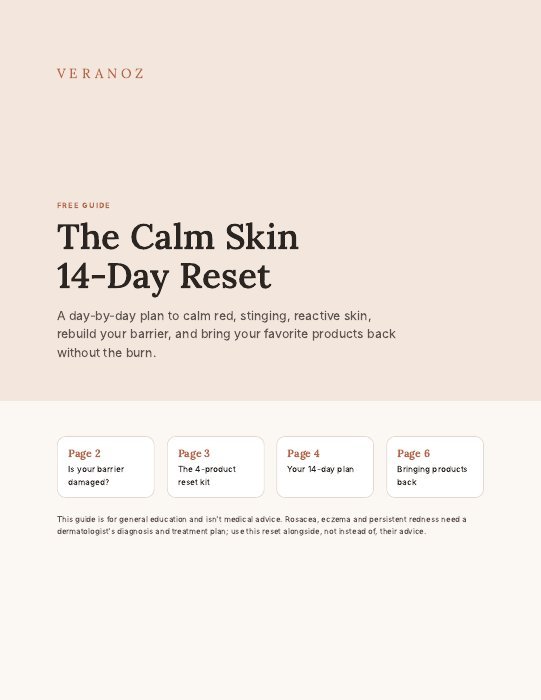
The Calm Skin 14-Day Reset
A day-by-day plan to calm red, stinging, reactive skin, with a 4-product reset kit and a daily symptom tracker.
Send me the free reset →After the reset: The Skincare Routine Builder has a full sensitive-skin blueprint and chapter, a gentle rotation calendar and a 4-week on-ramp for adding actives back without the sting. 28 pages, $24.
In This Guide
Why Sunscreen Matters for Rosacea
Sun exposure is one of the most widely reported rosacea triggers. UV light inflames the skin and, over time, contributes to visible blood vessels, persistent redness and thinning, the same damage that drives fine lines and dark spots. There’s a double benefit: the sunscreen that keeps rosacea calmer also slows fine lines and dark spots. The AAD recommends that people with rosacea protect their skin year-round with shade, protective clothing, a wide-brimmed hat, UV-blocking sunglasses and a broad-spectrum, water-resistant sunscreen with SPF 30 or higher.
| What sun does | Rosacea effect | Effect on lines and firmness |
|---|---|---|
| Inflames skin | Flushing and flares | Breaks down collagen |
| Heats skin | Triggers redness | Worsens dryness |
| Damages blood vessels | Visible vessels, persistent redness | Uneven tone |
| Darkens pigment | Uneven, blotchy look | Dark spots and melasma |
Mineral vs Chemical Sunscreen for Rosacea
Mineral (physical) filters, zinc oxide and titanium dioxide, are generally the gentlest option for reactive skin, which is why the AAD suggests a mineral sunscreen with zinc oxide and/or titanium dioxide, silicone and no fragrance if other sunscreens irritate you. Chemical filters aren’t off-limits, and some rosacea-prone people tolerate well-formulated ones, but they’re more likely to sting sensitive skin.
| Mineral | Chemical | |
|---|---|---|
| Filters | Zinc oxide, titanium dioxide | Avobenzone, homosalate, octisalate, octocrylene and others |
| Stinging risk | Lower | Higher for reactive skin |
| White cast | Possible; micronized or tinted versions help | Usually none |
| Feel | Can feel thicker | Usually lighter |
| Rosacea verdict | First choice | Try only if mineral doesn’t work for you |
Hybrid formulas, like EltaMD UV Clear (zinc oxide plus octinoxate), are a middle ground that many rosacea-prone people tolerate. For a deeper comparison, see our best mineral sunscreen for sensitive skin guide.
Related ReadBest Moisturizers for Rosacea-Prone SkinWhy Tinted Sunscreen Helps
Tinted mineral sunscreens use iron oxides for color. Independent ingredient analysis notes iron oxides help block visible light, which untinted formulas don’t do as well. That matters if you also deal with melasma or dark spots. There’s a cosmetic bonus too: a sheer tint evens out redness, so many women with rosacea can skip foundation. The AAD also points out that micronized or tinted mineral sunscreens help avoid a white cast, especially on darker skin tones.
For more, see our tinted sunscreen guide and melasma treatment that actually works.
What to Look For and Avoid
| Look for | Avoid |
|---|---|
| Broad spectrum, SPF 30+ | Fragrance (including “parfum”) |
| Zinc oxide and/or titanium dioxide | Alcohol high in the ingredient list |
| “Fragrance-free” (not “unscented”) | Menthol, camphor, peppermint, eucalyptus |
| Silicone base (dimethicone, cyclopentasiloxane) | Essential oils |
| Labeled for sensitive skin, non-comedogenic | Added acids (glycolic, lactic, salicylic) |
| Iron oxides if you want a tint | Sprays applied directly to the face |
| Water-resistant for outdoor activity | Anything that stung in a patch test |
Best Sunscreens for Rosacea
CeraVe Invisible Mineral Sunscreen SPF 50
Zinc oxide with ceramides and niacinamide in a fragrance-free formula.
Check on Amazon →Cotz Sensitive SPF 40
A minimalist, zinc oxide mineral sunscreen developed for sensitive skin and widely recommended for rosacea.
Check on Amazon →EltaMD UV Physical SPF 41
A tinted, mineral-only sunscreen with zinc oxide and titanium dioxide.
Check on Amazon →La Roche-Posay Anthelios Mineral Sunscreen SPF 50
A light, fragrance-free mineral fluid from a sensitive-skin brand.
Check on Amazon →EltaMD UV Clear SPF 46
Zinc oxide plus octinoxate, with niacinamide; oil-free and fragrance-free. Read our full review.
Check on Amazon →Blue Lizard Sensitive Mineral SPF 50+
A simple mineral sunscreen for sensitive skin; good for outdoor time.
Check on Amazon →Free: the Calm Skin 14-Day Reset
A simple 4-product routine, a barrier checklist and a 14-day tracker for red, stinging skin. Not medical advice: see a dermatologist for persistent redness.
Free. You will also get a few short emails with tips and offers. Unsubscribe anytime. Privacy policy.
Choose by Skin Type
| Your skin | Best pick | Why |
|---|---|---|
| Dry, thinning, rosacea-prone | CeraVe Invisible Mineral SPF 50 | Ceramides and niacinamide add comfort |
| Reacts to almost everything | Cotz Sensitive SPF 40 | Minimal ingredient list |
| Redness you want to cover | EltaMD UV Physical (tinted) | Iron oxide tint evens tone |
| Combination, dislikes heavy textures | La Roche-Posay Anthelios Mineral | Lightweight fluid |
| Bumps and breakouts | EltaMD UV Clear | Oil-free, niacinamide, light finish |
| Beach, pool, sports | Blue Lizard Sensitive Mineral | Water-resistant formula (check label) |
How to Apply Without a Flare
- Patch test first. Apply a little behind your ear or on your jaw for 3–5 days.
- Let your moisturizer settle for a few minutes. If you use rosacea medication in the morning, the National Rosacea Society suggests waiting 5–10 minutes after medication before sunscreen or makeup.
- Dot, then press. Dot sunscreen across the face, then press and pat it in gently instead of rubbing, which can trigger redness.
- Use enough: about two finger-lengths for the face and neck. Two thin layers spread more evenly than one thick one.
- Cover the edges: ears, neck, hairline and the sides of the nose.
- Reapply at least every 2 hours outdoors and after swimming or sweating.
- Add physical protection: a wide-brimmed hat and sunglasses, especially midday.
| Step | Morning routine |
|---|---|
| 1 | Gentle, non-soap cleanser, lukewarm water |
| 2 | Rosacea medication (if prescribed); wait until it absorbs |
| 3 | Rosacea-friendly moisturizer |
| 4 | Mineral SPF 30+, pressed in |
| 5 | Green-tinted concealer or mineral powder, if you like |
Need to top up over makeup? See our sunscreen reapplication over makeup guide.
Pro Tip
If even mineral sunscreen stings, the issue may be your barrier, not the sunscreen. Spend two weeks on a minimal routine (gentle cleanser, fragrance-free moisturizer and medication) and then patch test again. Applying sunscreen over a well-moisturized face also reduces stinging.
Mistakes to Avoid
- Skipping sunscreen because it stings. Switch to a mineral, fragrance-free formula instead.
- Rubbing it in hard. Friction triggers redness. Press and pat.
- Using too little. A thin smear gives far less protection than the label says.
- Relying on SPF in makeup. You’d need far more foundation than anyone wears.
- Forgetting heat. Sunscreen blocks UV but not heat. Shade and hats help with heat-triggered flushing.
- Spraying sunscreen on your face. Spray into your hands first, or use a lotion.
- Using expired sunscreen. Check the date, and replace bottles left in a hot car.
Your Rosacea Sunscreen Checklist
- Broad spectrum, SPF 30+
- Mineral filters: zinc oxide and/or titanium dioxide
- Fragrance-free, labeled for sensitive skin
- Tinted (iron oxide) if you want redness coverage or have melasma
- Patch test for 3–5 days
- Apply over moisturizer; press, don’t rub
- Reapply every 2 hours outdoors
- Hat, shade and sunglasses on high-UV days
Frequently Asked Questions
Is mineral sunscreen better for rosacea?
Usually, yes. The AAD suggests a mineral sunscreen with zinc oxide and/or titanium dioxide if other sunscreens irritate you.
Can chemical sunscreen make rosacea worse?
Some chemical filters can sting reactive skin, but not everyone reacts. If a chemical or hybrid sunscreen works for you without stinging, it’s fine to keep using it.
Is tinted sunscreen good for rosacea?
Yes. A tint helps hide redness, and iron oxides add visible-light protection, which is useful if you also have melasma.
Why does my sunscreen sting?
Common causes include fragrance, alcohol, certain chemical filters, or a damaged barrier. Try a fragrance-free mineral sunscreen over moisturizer.
Do I need sunscreen indoors?
If you sit near windows, UVA can pass through glass. See do you need to reapply sunscreen indoors.
Can I use sunscreen with metronidazole or azelaic acid?
Yes. Apply the medication first, let it absorb, then moisturizer and sunscreen.
What SPF do I need?
SPF 30 or higher, broad spectrum, as the AAD recommends. Applying enough matters more than a higher number.
Can sunscreen help rosacea redness?
It reduces sun-triggered flares and long-term damage. It won’t treat rosacea on its own, so see a dermatologist for treatment.
Sources: American Academy of Dermatology, 7 rosacea skin care tips, How to select a sunscreen and How to apply sunscreen; National Rosacea Society, Facial cleansing for rosacea; independent ingredient analysis from DermFND. Veranoz has not lab-tested every product listed. This article is informational and not medical advice.
Get the Free Self-Care Reset Kit
Daily, weekly and monthly self-care checklists, the everything shower order, a 3-hour at-home spa day plan and a 30-day reset tracker. Free printable, instant access.
The Veranoz 30-Day Glow-Up Planner
Routines only work when you actually keep them. The planner gives you daily planning pages, weekly resets and habit trackers so your skincare, body care and self-care steps become automatic instead of something you remember once in a while.
Veranoz Guides to Go Deeper
Some links on Veranoz are affiliate links; we may earn a commission at no extra cost to you. This content is informational and not medical advice.