

Disclosure: As an Amazon Associate, Veranoz earns from qualifying purchases. We may earn a commission if you buy through links in this post, at no extra cost to you.
The best thinning hair color ideas all do two things: they reduce the contrast between your hair and your scalp, and they add dimension so hair looks thicker than it is. That usually means a soft root shadow or “root smudge” a shade deeper than the lengths, fine lowlights woven underneath to create depth, a few babylights on top for movement, and no stark, high-contrast color right at the part. Choose a shade within about three levels of your natural color, favor gentle demi-permanent formulas when you can, and always patch and strand test, because thinning hair is often fragile hair.
Free: the Fuller-Looking Hair Cheat Sheet
The right cut for your hair type, a 5-minute volume blowout, a weekly routine that stops breakage and a 90-day tracker.
Free. You will also get a few short emails with tips and offers. Unsubscribe anytime. Privacy policy.
Below you’ll find the color strategies that make fine and thinning hair look fuller, the best approach for your base shade, tricks for a wide part or visible crown, how to keep color gentle on fragile strands, quick root cover-ups between appointments, and the mistakes that make thin hair look thinner.
The Real Problem
When hair thins, the scalp shows through, especially at the part and crown. Very dark, flat color on fair skin makes that contrast stronger; bright, chunky highlights can make hair look see-through; and over-processing makes fragile strands break, which leaves even less hair. Many women stop coloring altogether, or keep using the same box dye they’ve always used, and neither helps. The right color plan can make hair look noticeably fuller without adding damage.
Short Answer
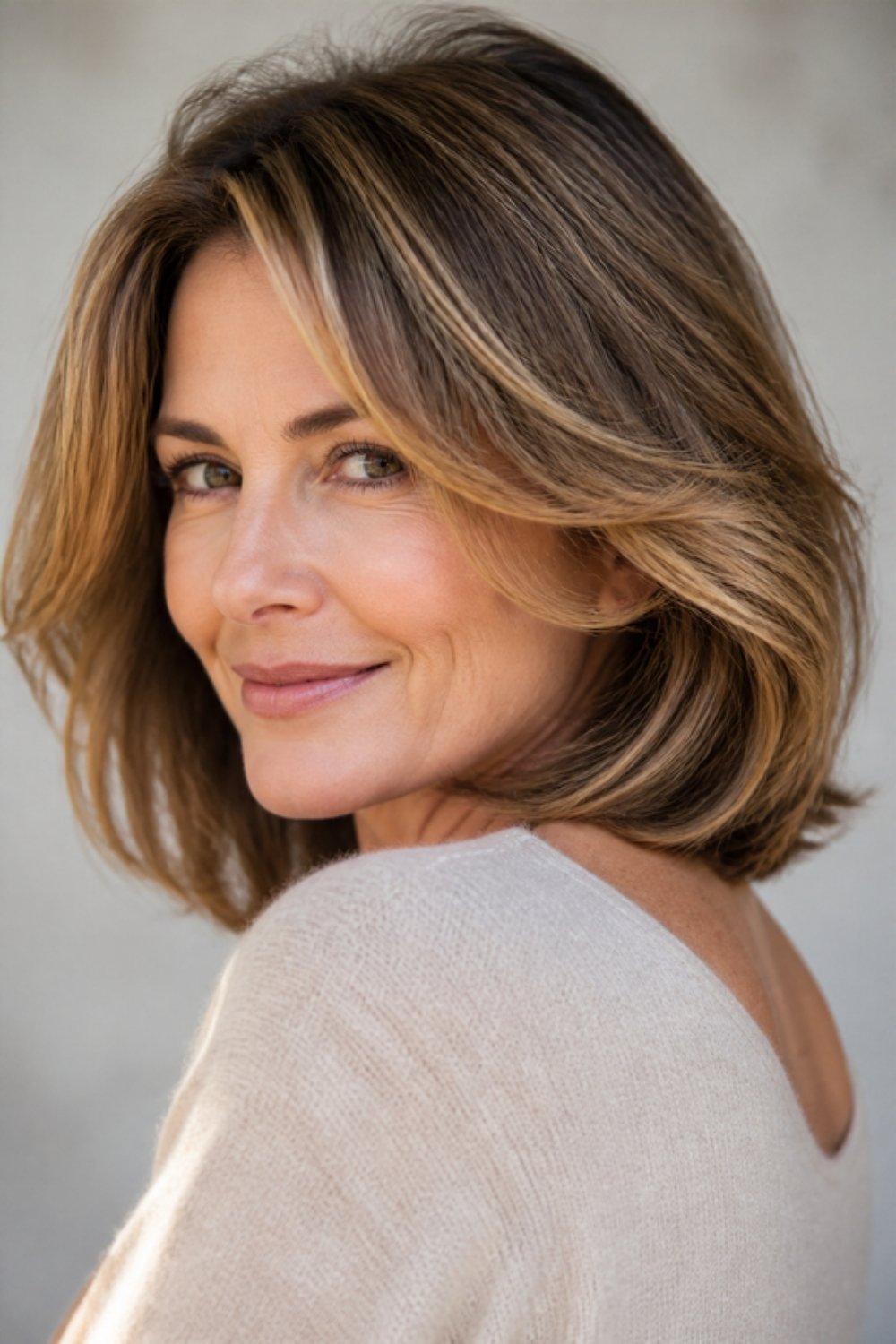
Best overall: a soft root shadow plus fine lowlights and babylights (dimensional color). Dark hair, fair skin: soften to a medium brown with caramel babylights so the scalp contrasts less. Blonde: add darker lowlights and a root shadow so hair stops looking transparent. Gray: a few lowlights and a gloss, not solid dark dye. At the part: keep color close to your scalp tone, avoid bright stripes, and try a zigzag part. Gentle: stay within three shades, choose demi-permanent where possible, ask about bond builders, patch test 48 hours ahead, and see a dermatologist about the thinning itself.
Fuller-Looking Hair Cheat Sheet
The right cut for your hair type, a 5-minute volume blowout, a weekly routine that stops breakage, and a 90-day tracker.
Send me the free cheat sheet →In This Guide
- How hair color makes thin hair look fuller
- The three rules of color for thinning hair
- 10 thinning hair color ideas
- Best color for thinning hair by base shade
- Wide part and visible crown: color tricks
- Keeping color gentle on fragile hair
- Root and scalp cover-ups between appointments
- What to tell your colorist
- Products for colored, thinning hair
- When to see a dermatologist
- Mistakes to avoid
- FAQ
How Hair Color Makes Thin Hair Look Fuller
MedlinePlus explains that over time, individual hair strands tend to get finer and lighter and many women develop less dense hair with a more visible scalp. You can’t change the number of hairs with color, but you can change how much the eye notices the gaps. Three things matter:
- Scalp contrast. The bigger the difference between hair color and scalp color, the more visible the scalp. Very dark hair on fair skin, or very light hair on deeper skin, shows the part most.
- Dimension. Several shades side by side create shadows and highlights, which the eye reads as depth and volume. One flat shade reads as one flat layer.
- Condition. Shiny, intact hair reflects light and moves; broken, frizzy, over-processed hair looks sparse. Gentle color protects what you have.
Many women also find that colored hair feels a little fuller and has more grip for styling than virgin fine hair, but that’s a styling bonus, not a reason to over-process.
The Three Rules of Color for Thinning Hair
- Blend the root into the scalp. Keep the color closest to the scalp soft, slightly deeper than the ends, and as close as possible to your scalp’s tone. No bright stripes at the part.
- Add depth before brightness. Lowlights and a root shadow create the illusion of density; highlights then add movement. Highlights alone often make thin hair look thinner.
- Protect the strand. The American Academy of Dermatology suggests staying within three shades of your natural color, since lightening further requires stronger peroxide and causes more damage. For women with hair loss, the AAD advises getting color done at a salon whose staff examine your scalp and hair first, rather than coloring at home.
Take a photo of your part and crown from above in daylight before and after a color appointment. It’s the clearest way to see whether a new color makes the scalp more or less visible.
10 Thinning Hair Color Ideas
| Color idea | What it is | Why it helps thin hair | Upkeep |
|---|---|---|---|
| 1. Root shadow (root smudge) | A slightly deeper shade blended at the roots | Mimics the natural shadow of thick hair; softens regrowth | Every 8 to 12 weeks |
| 2. Fine lowlights | Strands one or two shades deeper woven underneath and through the crown | Creates depth so hair reads as more layers | Every 8 to 12 weeks |
| 3. Babylights | Very fine, soft highlights | Adds movement without the see-through look of chunky highlights | Every 10 to 12 weeks |
| 4. Dimensional brunette | Two or three close brown tones mixed | Rich and full-looking on medium and dark bases | Every 8 to 10 weeks |
| 5. Soft balayage | Hand-painted lightness through mid-lengths and ends, starting below the root | Keeps the root natural; adds brightness away from the scalp | Every 3 to 4 months |
| 6. Gloss or glaze | Demi-permanent or semi-permanent tone and shine | Shiny hair looks healthier and thicker; gentle, no lift | Every 6 to 8 weeks |
| 7. Warm “lived-in” blonde | Beige or honey blonde with a deeper root | Less transparent than icy platinum on fine hair | Every 8 to 12 weeks |
| 8. Gray blending with lowlights | Lowlights through natural gray | Adds depth so silver hair doesn’t look wispy | Every 10 to 16 weeks |
| 9. Soft copper or strawberry | Warm, multi-tonal red | Warm tones reflect light and can look denser | Every 6 to 8 weeks (red fades) |
| 10. Face-frame brightening | A few lighter pieces at the front only | Brightens the face while keeping the crown and part deeper | Every 8 to 12 weeks |
Best Color for Thinning Hair by Base Shade
| Natural shade | Best strategy | Avoid |
|---|---|---|
| Black or very dark brown, fair to medium skin | Soften one or two shades to a rich medium brown; add caramel or toffee babylights; keep a soft dark root | Jet-black dye, which maximizes scalp contrast |
| Black or very dark brown, deeper skin | Stay close to your natural shade; add subtle espresso or chestnut dimension; gloss for shine | Bright highlights near the part |
| Medium brown | Dimensional brunette: lowlights plus a few honey babylights; root shadow | One flat all-over shade |
| Light brown or dark blonde | Beige or honey babylights with a darker root shadow and lowlights at the crown | Lightening the whole head to pale blonde |
| Blonde | Add depth: a root shadow and a few golden-beige lowlights so the hair stops looking transparent | Icy, all-over platinum on fine hair |
| Red or auburn | Multi-tonal copper with deeper auburn lowlights and a soft root | Bright single-process red on very sparse areas |
| Mostly gray or white | Keep the silver; add a few lowlights near your old base color and a clear or silver gloss | Solid dark dye over white roots, which shows regrowth fast |
If your scalp is fair and your hair is dark, going slightly lighter usually helps. If your hair is very light and your scalp shows pink, going slightly deeper at the root usually helps. The goal in both cases is the same: hair and scalp closer in tone.
Related ReadHealthy Looking Hair Routine That Feels SimpleWide Part and Visible Crown: Color Tricks
The AAD notes that a widening part is a key sign of female pattern hair loss, the most common type of hair loss in women. Color can’t treat it, but it can make it far less noticeable:
- Keep the part soft. Ask your colorist to leave the first inch at the part close to your natural shade or slightly deeper. Bright foils right at the part make the line wider.
- Zigzag or move your part. A slightly irregular part, or shifting it half an inch, hides the “stripe” and gives roots lift where they haven’t been flattened.
- Darker lowlights at the crown. A few deeper pieces around the whorl at the crown reduce the look of a see-through patch.
- Diffuse highlights. If you love highlights, place them below the top layer or in fine babylights rather than heavy foils on top.
- Use a tinted root cover-up on the part on special occasions (see below).
Don’t forget sun protection on a wide part. Scalp skin that’s newly exposed burns easily. A hat, or a sunscreen made for the scalp or part line, protects it.
Keeping Color Gentle on Fragile Hair
Thinning hair is often fine, dry and easily broken, so how you color matters as much as which color you choose.
| Color type | How it works | For thinning hair |
|---|---|---|
| Semi-permanent / gloss | Coats the hair with tone, fades in a few weeks; no lift | Gentlest; great for shine, toning gray and refreshing color |
| Demi-permanent | Low-ammonia or ammonia-free, deposits color with little lift; lasts several weeks | Good choice for root shadows, lowlights and blending gray |
| Permanent | Lifts and deposits; needed for full gray coverage or going lighter | Use sparingly; avoid overlapping onto previously colored lengths |
| Bleach / lightener | Removes pigment to go lighter | Fine babylights only, with a bond-building additive; avoid lifting the whole head |
Gentle-Color Rules
- Patch test every time. The FDA advises a skin test before every dye application, even with a product you’ve used before, because allergies can develop and formulas change. The NHS recommends testing at least 48 hours before coloring.
- Strand test fragile hair. A strand test shows how your hair takes the color and whether it can handle lightener.
- Space chemical services. The FDA recommends waiting at least 14 days after bleaching, relaxing or perming before dyeing.
- Skip color on an irritated scalp. Don’t dye if your scalp is sunburned, irritated or broken, and don’t scratch or brush hard before coloring.
- Ask about bond-building additives. Many salons add a bond-building treatment to lightener; ask whether yours does.
- Color the root, not the whole length, at each permanent-color visit. Refresh the ends with a gloss instead.
- Condition every time. The AAD advises asking the salon for a moisturizing conditioner after color and using conditioner after every shampoo; it also recommends avoiding hot-oil treatments on fragile hair.
- Turn down the heat. The AAD suggests the lowest dryer setting, air-drying when possible, and saving curling and flat irons for special occasions.
- Know your allergens. PPD (paraphenylenediamine) is common in permanent dyes; tell your colorist if you’ve reacted to hair dye or a black henna tattoo.
Free: the Fuller-Looking Hair Cheat Sheet
The right cut for your hair type, a 5-minute volume blowout, a weekly routine that stops breakage and a 90-day tracker.
Free. You will also get a few short emails with tips and offers. Unsubscribe anytime. Privacy policy.
Root and Scalp Cover-Ups Between Appointments
For days when the part looks wider or roots are showing, temporary products blend the scalp and hair. They wash out and don’t affect hair growth.
- Root touch-up powder: pressed tinted powder applied with a small brush along the part. Natural-looking and easy to control.
- Root spray: fast for larger areas; hold it at the distance on the label and let it dry before touching.
- Hair-building fibers: colored fibers that cling to existing hairs at the crown or part; set with a light hairspray.
- Tinted dry shampoo: adds grip and a hint of color to the roots on second-day hair.
Match the shade to your root color, not your ends, and apply lightly. Too much product looks flat and can rub off on pillows and collars.
What to Tell Your Colorist
Book a consultation first, and be honest about your hair history.
“My hair is thinning, mostly at the [part/crown/temples], and I’d like color that makes it look fuller. I’d like a soft root shadow, fine lowlights for depth and maybe a few babylights, but nothing bright at the part. I’d prefer demi-permanent where possible. I’ve used [box dye/henna/highlights] before. Can we do a strand test and use a bond builder if we lighten anything?”
Questions to ask:
- Will you look at my scalp before coloring?
- Which parts will be permanent and which demi-permanent or gloss?
- How will you keep the color off previously colored ends?
- How often will I need the root shadow refreshed?
- Can you pair the color with a cut that adds volume, such as soft, long layers or a blunt perimeter?
The cut matters as much as the color. Blunt ends and light layers usually look thicker on fine hair than heavy, choppy layers. Our Fuller Hair Playbook walks through cut, color and styling together.
Products for Colored, Thinning Hair
Root Touch-Up Powder
A tinted powder brushed along the part softens scalp contrast instantly and washes out with shampoo.
Check on Amazon →Bond-Building Treatment
At-home bond-building products are designed to support hair after chemical services. Use as directed alongside a moisturizing conditioner.
Check on Amazon →Color-Safe Volumizing Shampoo and Conditioner
Gentle, color-safe formulas help color last; lightweight conditioners on the ends avoid weighing roots down.
Check on Amazon →Hair-Building Fibers
Fibers cling to existing hairs to make sparse areas look denser. Set with a light mist of hairspray.
Check on Amazon →Leave-In Conditioner for Fine Hair
The AAD notes that a leave-in conditioner or detangler can reduce breakage, split ends and frizz. Choose a light spray.
Check on Amazon →Heat Protectant Spray
Protects fragile, colored strands and helps color stay vibrant longer.
Check on Amazon →Wide-Tooth Comb
The AAD recommends a wide-tooth comb for wet hair, starting at the ends and working up.
Check on Amazon →When to See a Dermatologist
Color is camouflage. If your hair is thinning, it’s worth finding out why. The AAD notes that female pattern hair loss is progressive, that treatment works best when started early, and that a dermatologist should diagnose the cause first because other conditions can look similar. Minoxidil (2% or 5%) is the FDA-approved over-the-counter option for women and takes six to twelve months to show results, so talk to a dermatologist about whether it suits you before coloring around the problem for years.
See a dermatologist promptly if you notice sudden or patchy shedding, scalp pain, itching, redness or scaling, or hair loss after starting a new medication. Tell your colorist about any scalp treatment you use, too; some treatments and dyes shouldn’t be applied on the same day.
Thinning Hair Color Mistakes to Avoid
- Jet-black or very dark single-process color on fair skin. It spotlights the scalp.
- Chunky, high-contrast highlights, especially at the part. They make hair look see-through.
- All-over platinum on fine hair. Heavy lightening breaks fragile strands.
- Overlapping permanent color onto previously colored ends at every visit.
- Box dye on fragile hair. The AAD advises people with hair loss to stop at-home coloring and choose a salon that examines the scalp first.
- Skipping the patch test because you’ve used a product before.
- Ignoring the cut. Thin, wispy ends undo the fullest-looking color.
- Using color instead of a diagnosis. Camouflage works best alongside treatment.
Thinning Hair Color Checklist
- Photograph your part and crown in daylight
- Pick a strategy: root shadow, lowlights, babylights, gloss
- Keep color within about three shades of your natural shade
- Nothing bright or high-contrast at the part
- Prefer demi-permanent and gloss where possible
- Patch test 48 hours ahead; strand test fragile hair
- Ask about bond builders for any lightening
- Conditioner every wash, low heat, wide-tooth comb
- Root powder or fibers for special occasions
- Dermatologist visit for a widening part or new shedding
The Fuller Hair Playbook
Your hair profile, 12 cuts that add fullness, three volume methods, camouflage and color tricks, a weekly anti-breakage routine, scripts for your stylist and doctor, and a 12-week tracker. Instant access.
See the Playbook ($19) →Frequently Asked Questions
What hair color makes thin hair look thicker?
Dimensional color: a soft root shadow, fine lowlights and a few babylights, in shades that keep your hair close to your scalp tone. Flat, very dark or very light single shades usually make thinning more visible.
Is it better to go lighter or darker with thinning hair?
It depends on your scalp. Dark hair on fair skin often looks fuller a shade or two lighter; very light hair often looks fuller with a deeper root and lowlights. Aim to reduce the contrast between hair and scalp.
Does hair dye cause hair loss?
Coloring doesn’t usually cause gradual, pattern-type thinning, but harsh chemical services and heat can make fragile hair break. Allergic reactions to dye can also inflame the scalp. Keep color gentle and patch test every time.
Are highlights good for thinning hair?
Fine babylights can be, especially combined with lowlights and a root shadow. Chunky, high-contrast highlights near the part usually make thin hair look thinner.
Is demi-permanent color better for thinning hair?
Often, yes. It deposits color with little or no lift, so it’s gentler than permanent color and works well for root shadows, lowlights, gray blending and gloss.
How can I hide a wide part with color?
Keep the part soft and close to your scalp tone, add deeper lowlights near the crown, avoid bright foils at the part, try a zigzag part, and use a tinted root powder for special occasions.
Should I see a doctor before coloring thinning hair?
If your hair is thinning, see a board-certified dermatologist to find the cause. Color is safe to use alongside most treatments, but ask about timing.
Sources: American Academy of Dermatology, Female pattern hair loss; American Academy of Dermatology, Hair loss: Tips for managing; American Academy of Dermatology, Coloring and perming tips for healthier-looking hair; American Academy of Dermatology, Tips for healthy hair; U.S. Food and Drug Administration, Hair dyes; NHS, Hair dye allergy; MedlinePlus (NIH), Hair and nail changes. Veranoz has not tested every product listed. This guide is general information, not medical advice; see a board-certified dermatologist for hair loss.
Get the Free Self-Care Reset Kit
Daily, weekly and monthly self-care checklists, the everything shower order, a 3-hour at-home spa day plan and a 30-day reset tracker. Free printable, instant access.
The Veranoz 30-Day Glow-Up Planner
Routines only work when you actually keep them. The planner gives you daily planning pages, weekly resets and habit trackers so your skincare, body care and self-care steps become automatic instead of something you remember once in a while.
Veranoz Guides to Go Deeper
Some links on Veranoz are affiliate links; we may earn a commission at no extra cost to you. This content is informational and not medical advice.