
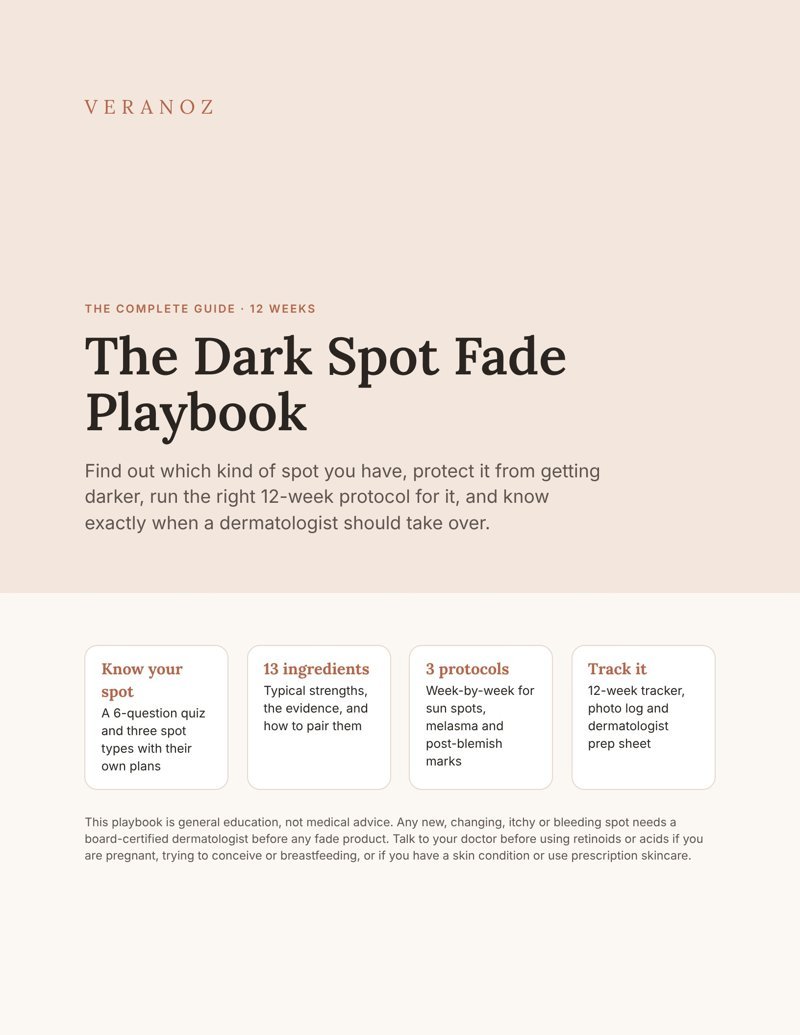
Fade dark spots the way dermatologists do: by spot type, over 12 weeks
Find out which kind of spot you have, protect it from getting darker, run the right 12-week protocol for sun spots, melasma or post-blemish marks, and know exactly when a dermatologist should take over.
Get the Playbook: $19 →Secure checkout by Stripe. Instant PDF download, US Letter, prints well on A4.
7-day refund: email hello@veranoz.com within 7 days of purchase for a full refund. 7-day refund policy
Sound familiar?
- You’ve bought three “dark spot correctors” and the spots look exactly the same, or darker.
- Something new appeared on your cheek or the back of your hand and you’re not sure if it’s a sun spot, melasma or something to get checked.
- You started strong, your skin got red and flaky, and you quit by week three.
- Every summer undoes whatever progress you made in winter.
- You don’t know whether a retinoid, vitamin C, azelaic acid or tranexamic acid is the right one for your spots.
Dark spot routines fail for three reasons: the wrong ingredient for that kind of spot, not enough light protection to stop the spot re-darkening, and quitting before the 8 to 12 weeks it takes to see a change. The American Academy of Dermatology puts the realistic timeline at 6 to 12 months for a spot to fade once its cause is removed, and 3 to 12 months for melasma with treatment. The Playbook is built around those facts: the right plan for your spot type, strict sun rules, and a tracker that keeps you going to week 12.
Instant PDF download · 7-day refund policy
What’s inside
| Section | What you get |
|---|---|
| Which spot is it? | A 6-question quiz that sorts sun spots, melasma and post-blemish marks, plus the ABCDE warning signs that mean a dermatologist, not a cream |
| Rule #1: protect, then fade | Why tinted iron-oxide sunscreen matters, how much to use, reapplication, window and car light, and the week-1 habit that decides everything else |
| Ingredient library (13 ingredients) | Vitamin C, azelaic acid, niacinamide, tranexamic acid, alpha arbutin, retinoids, AHAs, kojic acid, licorice, and the prescription tier (hydroquinone, cysteamine, triple cream, oral TXA): typical strengths, the evidence, who should skip them |
| Pairing rules | A what-goes-with-what chart, the AM/PM order, and the two-week rule |
| Protocol A, B and C | Week-by-week 12-week plans for sun spots, melasma and post-blemish marks, with what to expect each phase |
| Sensitive skin and retinoid users | The gentler version, how to slot fading actives around a retinoid you already use, and notes for hormone-related skin changes |
| Rotation calendars | Printable night-by-night calendars for every protocol |
| Hands, chest, underarms and legs | Body-specific causes and a gentleness ladder of body actives |
| Covering spots while they fade | Color-correcting by skin tone without a heavy base |
| Shopping worksheet | Five products, not fifteen: what the label must show and what to avoid, by protocol |
| What a dermatologist can do | Prescription options, peels, microneedling, lasers (and when they backfire), plus the questions to bring |
| Troubleshooting, maintenance, myths | 11 problems solved, the after-week-12 plan, the vacation protocol, 9 myths corrected |
| Trackers | 12-week tracker, photo log, reaction log and product inventory, dermatologist prep sheet, monthly self-check |
Instant PDF download · 7-day refund policy
Free Fade Plan vs the Playbook
| Free Dark Spot Fade Plan | The Playbook | |
|---|---|---|
| Length | 6 pages | 26 pages |
| Spot types | One general 12-week plan | Three separate protocols: sun spots, melasma, post-blemish marks |
| Ingredients | Chooser table (8 ingredients) | 13 ingredients with strengths, evidence and pairing chart |
| Sensitive skin / already on a retinoid | No | Yes, adapted plans |
| Body spots and makeup coverage | Links only | Full chapters |
| Dermatologist options | When to go | What they can do, risks by skin tone, questions to bring, prep sheet |
| Tracking | Photo tracker | 12-week tracker, photo log, reaction log, inventory, self-check |
Haven’t got the free plan yet? Get the free Dark Spot Fade Plan.
Instant PDF download · 7-day refund policy
Who it’s for
- Anyone with sun spots on the face, hands or chest who want a plan that actually gets to week 12
- Anyone with melasma who is tired of products that promise two-week miracles
- Anyone whose breakouts, shaving or bites leave marks that linger for months
- Sensitive, redness-prone and medium-to-deep skin tones, with adapted plans for each
Not a substitute for a dermatologist. Any new, changing, itchy or bleeding spot needs a professional evaluation before any fade product. The Playbook explains the warning signs and what to ask.
The Dark Spot Fade Playbook: $19
- A 26-page printable PDF (US Letter, prints well on A4), instant download
- Spot-type quiz, a 13-ingredient library and three 12-week protocols: sun spots, melasma and post-blemish marks
- Rotation calendars, a 12-week tracker, photo log, reaction log, product inventory and a dermatologist prep sheet
- One-time payment, secure checkout by Stripe
7-day refund: email hello@veranoz.com within 7 days of purchase for a full refund.
The Dark Spot Fade Playbook
26 pages · spot-type quiz, 13 ingredients, 3 protocols, calendars, body spots, dermatologist guide, 12-week tracker
Get the Playbook: $19 →7-day refund guarantee
If the Playbook isn’t right for you, email hello@veranoz.com within 7 days of purchase with your order details and the subject “Refund Request”, and we will refund you in full. Details are on our refund policy page.
Questions
Is this a physical book? No. After checkout you get an instant PDF download link on the confirmation page and by email. Print it or use it on a phone or tablet.
Will it recommend specific brands? It gives you the criteria (ingredient, strength, what to avoid on the label) so it works with whatever is sold where you live. For product ideas, the Veranoz dark spot guides go further.
Will my spots be gone in 12 weeks? Some will be clearly lighter; melasma and deep spots take longer and sometimes need a dermatologist. The Playbook tells you what to expect for each spot type and when to escalate.
Can I use it if I’m pregnant or breastfeeding? The protocols flag which ingredients to skip and offer azelaic acid as the usual alternative. Ask your doctor first.
Is this medical advice? No. It is general education based on American Academy of Dermatology guidance and peer-reviewed studies, all listed in the sources page.
Sources used in the Playbook include the American Academy of Dermatology (fading dark spots; melasma treatment), Boukari et al. JAAD 2015 (iron-oxide sunscreen and melasma relapse), Zhang et al. 2018 (tranexamic acid meta-analysis), Baliña & Graupe 1991 (azelaic acid vs hydroquinone), Navarrete-Solís et al. 2011 (niacinamide vs hydroquinone), Espinal-Pérez et al. 2004 (vitamin C vs hydroquinone), Mansouri et al. BJD 2015 (cysteamine) and FDA notices on hydroquinone. Written with AI assistance and reviewed before publishing.