

Disclosure: As an Amazon Associate, Veranoz earns from qualifying purchases. Some other links are affiliate links too. We may earn a commission at no extra cost to you. Veranoz hasn’t tested every product listed; picks are based on ingredient lists, brand information, dermatologist guidance and published retinoid research.
If your skin turns pink when the wind blows, stings under a “gentle” moisturizer or still remembers the last retinol you tried, you’ve probably heard two opposite pieces of advice: “sensitive skin can’t use retinol” and “just push through it.” Neither is right. After 40, retinoids are still one of the best-studied ingredients for fine lines, rough texture and uneven tone, and plenty of women with reactive skin use them every week. The difference is in what you pick and how you use it. This guide covers which retinoid types are gentlest, the formula details that matter more than the percentage, who should skip retinol entirely, a slow-start schedule built for sensitive skin, and the best retinols for sensitive, mature skin.
Free: the 12-Week Retinol Starter Plan
Which retinoid to pick, a night-by-night 12-week ramp-up calendar, how to tell purging from irritation and a printable progress tracker.
Free. You will also get a few short emails with tips and offers. Unsubscribe anytime. Privacy policy.
The Real Problem
Most retinol products are designed for “normal” skin and marketed on strength. Sensitive skin over 40 has a thinner, drier barrier that recovers more slowly, so a formula that’s fine for your friend can leave you red, flaky and stinging for a week. Then the retinol goes in a drawer and you lose the one ingredient most likely to help. The fix isn’t a stronger product or toughing it out. It’s a gentler retinoid, a soothing base, fewer other actives and a much slower start.
Short Answer
Best overall: a fragrance-free retinoid in a moisturizing cream base, such as Olay Regenerist Retinol 24 Night Moisturizer Fragrance-Free. Best serum: First Aid Beauty Skin Lab Retinol Serum 0.25%, a low-strength, fragrance-free retinol with soothing oat and allantoin. Best step-up for tolerant sensitive skin: Avène RetrinAL 0.1 Intensive Cream (retinaldehyde). How to start: two nights a week, a pea-sized amount on dry skin, sandwiched between moisturizer, for at least two weeks before adding a night. Skip retinoids and see a dermatologist if you have a lot of redness or rosacea, active eczema or a skin allergy, and don’t use them if you’re pregnant, trying to conceive or breastfeeding.
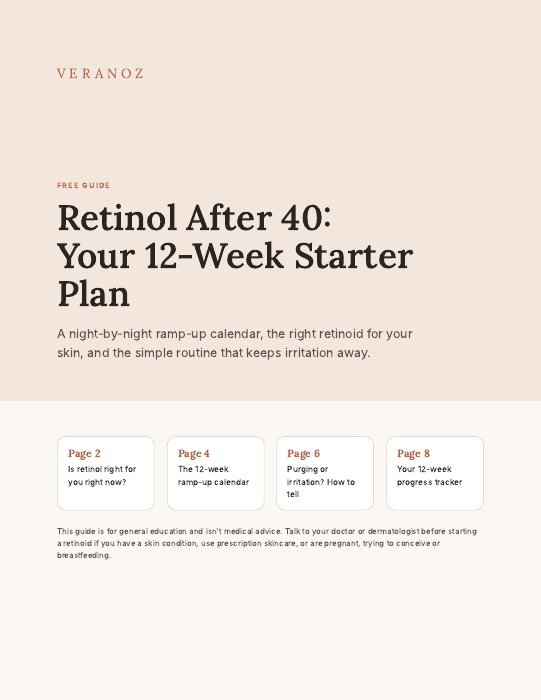
Retinol After 40: Your 12-Week Starter Plan
Which retinoid to pick, a night-by-night ramp-up calendar, purging vs irritation, and a printable tracker. Start retinol without the peeling.
Send me the free plan →In This Guide
- Can sensitive skin use retinol?
- Who should skip retinol (or ask a dermatologist first)
- Retinoid types from gentlest to strongest
- What makes a retinol gentle (it isn’t just the percentage)
- Ingredients to avoid in a sensitive-skin retinol
- The best retinols for sensitive skin over 40
- Quick comparison
- How to start: the sensitive-skin schedule
- A sample routine
- If your skin reacts anyway
- Mistakes to avoid
- FAQ
Can Sensitive Skin Use Retinol?
Usually, yes, as long as “sensitive” means skin that reacts easily to products, weather or fragrance, not an active skin condition. The American Academy of Dermatology (AAD) describes retinoids as a good option for mild fine lines and wrinkles, mild pigmentation and mild acne. Its featured dermatologists’ advice for everyone is the same advice sensitive skin needs most: use the least-intense retinoid formula you can find, apply it every other night at first and build up slowly. As Dr. Tina Alster, a board-certified dermatologist at Georgetown University, puts it, people who skip that step “end up irritating their skin.”
The reason a gentle retinol can still work is in how retinoids act. Over-the-counter retinol has to be converted in the skin into retinoic acid, the active form in prescription tretinoin. That conversion makes it slower and milder. A 2016 study in the Journal of Cosmetic Dermatology (Kong and colleagues) compared retinol with retinoic acid on human skin: after four weeks both increased epidermal thickness and switched on genes for collagen types I and III, with retinol’s effect tending to be smaller in size, and facial image analysis showed a significant reduction in wrinkles after 12 weeks of retinol. In other words, the gentler route still gets you to real results. It just takes patience.
Tolerance differs a lot by retinoid type, too. In a 1999 study in Dermatology (Fluhr and colleagues), retinol and retinaldehyde had a similarly low irritation potential in short-term testing, while retinoic acid was clearly more irritating. In the long-term part of the study, retinoic acid caused redness in 44% of people and scaling in 35% during the first four weeks, significantly more often than retinaldehyde. That’s why sensitive skin should start with cosmetic retinoids, not jump to prescription strength.
Related ReadRetinol After 40: A Beginner Routine That Won’t Wreck Your SkinWho Should Skip Retinol (or Ask a Dermatologist First)
“Sensitive” covers a lot of ground. For some people, the right move is a different ingredient or a dermatologist visit first:
- A lot of redness or inflammation, or diagnosed rosacea. The AAD quotes dermatologist Dr. Anne Chapas: people with a lot of redness or inflammation should avoid retinoids and ask a dermatologist about therapies directed at rosacea. (Some dermatologists do use low-strength retinaldehyde for rosacea-prone skin, more on that below, but that’s a decision to make with them.)
- Skin allergies or very dry skin. The AAD notes these people are probably not good candidates for retinoids.
- Active eczema, perioral dermatitis or a current rash. Treat the flare first. Retinoids on broken or inflamed skin usually make things worse.
- Pregnancy, trying to conceive or breastfeeding. Retinoids aren’t recommended. Ask your doctor about alternatives such as azelaic acid or bakuchiol.
- Hormonal or cyclical acne, or moderate to severe acne scarring. The AAD advises seeing a board-certified dermatologist before trying a retinoid.
- Recent procedures. After peels, laser or waxing, follow your provider’s timing. Retinoids and waxing in particular don’t mix.
If you’re in one of these groups, a retinol alternative may be the better first step. See retinol vs bakuchiol for beginners and peptides vs retinol for fine lines.
Pro Tip
If you have medium or deep skin, irritation can leave dark marks behind. The AAD’s Dr. Sonia Badreshia-Bansal advises being especially watchful for irritation with skin of color, and notes that starting slowly and using moisturizer helps. A slow start isn’t optional for you; it’s how you keep retinol from creating the spots you want it to fade.
Retinoid Types, From Gentlest to Strongest
Every retinoid has to end up as retinoic acid to work. The more conversion steps it needs, the gentler (and slower) it usually is.
| Retinoid | Where you find it | Gentleness | Strength | Good for sensitive skin? |
|---|---|---|---|---|
| Retinyl esters (retinyl palmitate, propionate, acetate) | Drugstore creams | Gentlest | Weakest | Yes, as a first step |
| Hydroxypinacolone retinoate (HPR, “Granactive Retinoid”) | Budget serums, emulsions | Gentle | Mild; less independent research | Often, yes |
| Retinol | Most anti-aging serums and creams | Moderate | Moderate, well studied | Yes, at low strength, in a soothing base |
| Retinaldehyde (retinal) | Pharmacy and specialty brands | Similar to retinol in testing | Faster acting than retinol | For skin that already tolerates retinol |
| Adapalene | Over the counter (acne gel) | Can be drying | Strong | Usually not as a first retinoid |
| Tretinoin, tazarotene | Prescription | Most irritating | Strongest | Only with a dermatologist’s plan |
A note on percentages: the AAD’s Dr. Chapas points out there’s no requirement for over-the-counter products to disclose their retinol percentage, and her advice is to use the lowest formulation you can find. When a percentage is listed, 0.1%–0.3% retinol is a sensible starting range for sensitive skin. Don’t compare percentages across types, either: 0.1% retinaldehyde is not “weaker” than 0.3% retinol.
Curious about the stronger options? We compare them in night cream vs retinol over 40 and walk through how each one fits a routine in our beginner routine.
What Makes a Retinol Gentle (It Isn’t Just the Percentage)
Two retinols at the same strength can feel completely different on reactive skin. These formula details matter as much as the number on the box:
- A moisturizing base. A retinoid built into a cream gets buffered by the oils and humectants around it. Thin, watery or alcohol-heavy serums deliver the retinoid faster and tend to sting more.
- Barrier-support ingredients alongside it. Niacinamide, ceramides, glycerin, panthenol, colloidal oatmeal and allantoin help the skin hold water while it adjusts. There’s evidence behind this: in a split-face, double-blind study published in Cutis (Draelos, Ertel and Berge, 2006), women with photodamage used a moisturizer with niacinamide, panthenol and vitamin E on one side of the face and a similar moisturizer without those vitamins on the other, starting two weeks before tretinoin. The researchers concluded that improving the skin barrier before and during treatment made the early phase of retinization easier and improved the response.
- Encapsulation or slow release. Many brands wrap retinol in carriers that release it gradually. It’s a reasonable feature, though the independent evidence varies from product to product, so treat it as a bonus, not a guarantee.
- Fragrance-free. Fragrance is a common trigger for sensitive skin and adds nothing to how a retinol works.
- Few other actives. A retinol “boosted” with acids or high-strength vitamin C is a recipe for stinging on sensitive skin. Keep those for separate nights, if at all.
- Opaque, airless packaging. Retinoids break down with light and air. A degraded product isn’t gentler, just less effective, and it tempts you to use more.
Not sure how to read a label? Our skincare ingredient label guide shows where fragrance and alcohol hide in an INCI list.
Ingredients to Avoid in a Sensitive-Skin Retinol
| Ingredient on the label | Why it matters for sensitive skin |
|---|---|
| Fragrance, parfum, essential oils (lavender, citrus, peppermint) | Common irritants and allergens, with no benefit for results |
| Alcohol denat. or SD alcohol high on the list | Can be drying and increase stinging on an already-stressed barrier |
| Glycolic, lactic or salicylic acid in the same product | Stacks a second exfoliant on top of the retinoid |
| Menthol, camphor, eucalyptus | “Tingle” ingredients that irritate reactive skin |
| Very high or undisclosed “max strength” retinoids | Too much for a first retinoid on sensitive skin |
Small amounts of denatured alcohol don’t bother everyone, and some popular retinols contain it. If you’ve reacted to a retinol before, look for one without fragrance or alcohol near the top of the ingredient list.
The Best Retinols for Sensitive Skin Over 40
These picks are chosen for sensitive, mature skin: fragrance-free or with no added fragrance listed, built with soothing or barrier-supporting ingredients, and widely available. Start with the gentlest one that fits your skin and only move up once you’ve used it comfortably for a few months.
Olay Regenerist Retinol 24 Night Moisturizer Fragrance-Free
A retinoid complex with niacinamide in a moisturizing night cream, in a fragrance-free version. Because the retinoid sits in a moisturizer base, it’s one of the easiest ways for reactive skin to get started. Use it alone on retinoid nights instead of adding another cream on top, or under a plain moisturizer if you’re very dry.
Check on Amazon →First Aid Beauty Skin Lab Retinol Serum 0.25% Pure Concentrate
Fragrance-free 0.25% retinol with a peptide and the brand’s soothing complex of colloidal oatmeal, allantoin, aloe, ceramides and hyaluronic acid. The brand reports that in its 8-week study, about half of the participants had self-described sensitive skin and 94.6% found it gentle. That’s brand data, not an independent trial, but the formula is built the right way for reactive skin. The brand’s own directions start at up to three nights a week; sensitive skin should start at two.
Check on Amazon →Paula’s Choice Clinical 0.3% Retinol + 2% Bakuchiol Treatment
A fragrance-free treatment that pairs 0.3% retinol with 2% bakuchiol, plus peptides, ceramide and licorice-derived ingredients. A rich, lotion-like texture makes it easier on dry, mature skin than many serums. Better as a second step after a gentler starter than as your very first retinoid.
Check on Amazon →Avène RetrinAL 0.1 Intensive Cream
A fragrance-free retinaldehyde cream with niacinamide and hyaluronic acid, from a brand built around sensitive skin. Retinaldehyde is one step closer to retinoic acid than retinol, so it tends to work faster. Start at two nights a week even if you’re used to nightly retinol, because it behaves like a stronger product.
Check on Amazon →The Ordinary Granactive Retinoid 2% Emulsion
Uses hydroxypinacolone retinoate (HPR), a retinoid ester that’s generally described as gentler than retinol, in a light emulsion. “2%” refers to the Granactive Retinoid ingredient complex, not 2% pure retinoid. Independent research on HPR is thinner than on retinol, so think of it as an affordable, low-drama starting point.
Check on Amazon →Vanicream Daily Facial Moisturizer
A fragrance-free moisturizer with ceramides, squalane and hyaluronic acid from a brand that formulates without common irritants. Apply a thin layer before and after your retinoid to soften its impact on sensitive skin.
Check on Amazon →EltaMD UV Clear Broad-Spectrum SPF 46
A lightweight sunscreen with zinc oxide (plus octinoxate) and niacinamide, popular with dermatologists for redness-prone skin. The AAD notes retinoids make skin more sun-sensitive and suggests a sunscreen with zinc oxide or titanium dioxide if you have sensitive skin. If you want zinc and titanium only, choose a fully mineral formula instead.
Check on Amazon →Pro Tip
A popular pick you may expect to see here is La Roche-Posay Retinol B3 Serum. It’s a well-made retinol with niacinamide, but ingredient lists we checked include fragrance (parfum) and denatured alcohol, so we don’t list it as a first choice for reactive skin. If it already works for you, there’s no reason to switch.
Free: the 12-Week Retinol Starter Plan
Which retinoid to pick, a night-by-night 12-week ramp-up calendar, how to tell purging from irritation and a printable progress tracker.
Free. You will also get a few short emails with tips and offers. Unsubscribe anytime. Privacy policy.
Quick Comparison
| Product | Retinoid | Base | Soothing extras | Best for |
|---|---|---|---|---|
| Olay Retinol 24 Fragrance-Free | Retinoid complex | Night cream | Niacinamide | First retinoid, dry skin |
| FAB Skin Lab Retinol 0.25% | Retinol 0.25% | Serum | Oat, allantoin, ceramides, peptide | Sensitive serum users |
| Paula’s Choice 0.3% Retinol + 2% Bakuchiol | Retinol 0.3% | Lotion-like treatment | Bakuchiol, peptides, ceramide | Second step |
| Avène RetrinAL 0.1 | Retinaldehyde 0.1% | Cream | Niacinamide, hyaluronic acid | Step-up |
| The Ordinary Granactive Retinoid 2% | HPR complex | Light emulsion | Minimal | Budget starter |
| Vanicream Daily Facial Moisturizer | None | Lotion | Ceramides, squalane | Buffering |
| EltaMD UV Clear SPF 46 | None | Sunscreen | Zinc oxide, niacinamide | Every morning |
More moisturizer and SPF options by skin type: best moisturizers for women over 40 and best sunscreens for women over 40.
How to Start: The Sensitive-Skin Schedule
This is slower than most “how to use retinol” advice on purpose. Sensitive skin over 40 does better with a schedule that feels almost too cautious.
| Weeks | Retinoid nights | How | Move on when |
|---|---|---|---|
| Before you start | 0 | Patch test behind the ear or on the jaw for 7–10 nights; strengthen your barrier with a simple moisturizer routine | No redness, itching or stinging |
| 1–2 | 2 (e.g., Mon, Thu) | Moisturizer sandwich, pea-sized amount | Skin feels normal the next morning |
| 3–6 | 2 | Same; stay here longer if there’s any flaking | Two weeks with no stinging |
| 7–10 | 3 (e.g., Mon, Wed, Fri) | Sandwich or retinoid then moisturizer | Comfortable for two weeks |
| 11+ | 3–4, or every other night | Keep what works; nightly isn’t required | Judge results at 12 weeks |
The step-by-step:
- Cleanse gently at night and pat skin dry. Wait 10–20 minutes so your face is completely dry, since damp skin absorbs retinoids faster and stings more.
- Protect the hot spots. A thin layer of petroleum jelly or balm on the corners of the nose, mouth creases and under the eyes.
- Moisturizer first (thin layer), if you’re using the sandwich.
- A pea-sized amount of retinoid for the whole face, dotted on forehead, cheeks and chin, then spread. Keep it off the eyelids and lips.
- Moisturizer again on top.
- Sunscreen every morning, SPF 30 or higher, even on cloudy days.
On non-retinoid nights, just cleanse and moisturize. Give it time: judge fine lines and texture at about 12 weeks, not two. If you’d like this mapped out night by night, our free Retinol After 40 Starter Plan includes a 12-week calendar and tracker.
A Sample Sensitive-Skin Routine
| Time | Step | Notes |
|---|---|---|
| Morning | Rinse or gentle cleanser | Lukewarm water only if your skin is dry |
| Morning | Moisturizer | Fragrance-free, with ceramides or glycerin |
| Morning | Mineral SPF 30+ | Zinc oxide or titanium dioxide |
| Retinoid night | Gentle cleanser → wait until dry → moisturizer → retinoid → moisturizer | No acids, scrubs or vitamin C serum the same night |
| Rest night | Gentle cleanser → moisturizer | Add a soothing balm on any dry patches |
Want vitamin C or an exfoliant too? Hold off until your retinoid has felt easy for at least six to eight weeks, then add one product at a time on separate days. Our skin cycling routine for beginners shows how to rotate actives without overload.
If Your Skin Reacts Anyway
A little dryness or light flaking in the first weeks is common. Stinging when you apply plain moisturizer, redness that lasts into the next day, or a raw, shiny look means it’s too much:
- Pause the retinoid for 3–7 nights, along with any acids, scrubs and fragranced products.
- Moisturize generously and use a balm on raw spots.
- Restart at two nights a week with the sandwich once moisturizer no longer stings.
- If it keeps happening at the same step, drop to a gentler retinoid type rather than forcing it.
- Stop and see a doctor for blistering, swelling, oozing, crusting, intense itching or a rash that spreads beyond where you applied the product.
Not sure whether you’re purging or irritated? Our guide to retinol purging vs irritation has a side-by-side table and a 60-second check. For a barrier rescue, see how to repair your skin barrier and how to calm irritated skin gently.
Pro Tip
About rosacea and retinaldehyde: in a small exploratory study published in Dermatology (Vienne and colleagues, 1999), 23 women with vascular signs of rosacea used a 0.05% retinaldehyde cream once daily for six months, and about 75% of those with persistent redness improved by at least one grade after five months. It’s an interesting result, but small and uncontrolled. If you have rosacea, talk to your dermatologist before trying any retinoid.
Mistakes to Avoid
- Choosing a retinol by the highest percentage on the shelf
- Starting nightly “because it’s a gentle formula”
- Applying retinol to damp skin straight out of the shower
- Using retinol, an acid toner and vitamin C serum in the same routine while you’re adjusting
- Skipping the patch test because a product is labeled “for sensitive skin”
- Starting a retinoid and a new moisturizer in the same week, so you can’t tell what caused a reaction
- Calling redness and stinging “purging” and pushing through
- Forgetting the neck and chest are even thinner; go slower there
- Skipping daily sunscreen
- Giving up at week four, before retinol has had time to work
Sensitive-Skin Retinol Checklist
- No active rosacea, eczema or rash; not pregnant or breastfeeding
- Fragrance-free formula, ideally in a cream or lotion base
- Lowest strength available (0.1%–0.3% retinol, or a retinyl ester or HPR)
- Patch tested for 7–10 nights
- Two nights a week, pea-sized, on dry skin
- Moisturizer sandwich and balm on the creases
- No acids or vitamin C on retinoid nights
- Mineral SPF 30+ every morning
- Judge results at 12 weeks
Frequently Asked Questions
What is the gentlest form of retinol?
Retinyl esters such as retinyl palmitate or propionate are the gentlest but also the weakest. Hydroxypinacolone retinoate (HPR) is another gentle option. Among true retinol products, a low strength (0.1%–0.3%) in a fragrance-free cream base is usually best tolerated.
What percentage of retinol should I start with if I have sensitive skin?
When the strength is listed, start around 0.1%–0.3% retinol. Many products don’t list a percentage; in that case, choose a product marketed for beginners or sensitive skin and follow a slow schedule.
Is retinaldehyde better than retinol for sensitive skin?
In testing, retinaldehyde and retinol had similarly low irritation potential, and retinaldehyde tends to work faster. For most sensitive skin, it’s better as a second step once a gentle retinol feels easy.
Can I use retinol if I have rosacea?
Ask your dermatologist first. The AAD advises people with a lot of redness or inflammation to avoid retinoids and get rosacea-directed treatment. Some dermatologists do use low-strength retinaldehyde for rosacea-prone skin under supervision.
Should I put moisturizer before or after retinol?
For sensitive skin, both. A thin layer before and after (the moisturizer sandwich) softens the retinoid. Research on tretinoin found that a barrier-supporting moisturizer used before and during treatment made the early weeks easier.
Is bakuchiol better for sensitive skin than retinol?
Bakuchiol is plant-based, not a retinoid, and is generally gentler. It has less research behind it than retinol but is a reasonable option if retinoids keep irritating you or you can’t use them.
How long until I see results?
Smoother texture can show up in a few weeks; fine lines and tone usually take about 12 weeks of consistent use. Take a photo in the same light on day 1 so you can compare fairly.
Can I use retinol around my eyes if I’m sensitive?
Keep regular retinol off the eyelids and lash line. If you want to treat under-eye lines, use a product made for the eye area, only a couple of nights a week, and stop if your eyes sting or water.
Is retinol safe during pregnancy?
Retinoids aren’t recommended during pregnancy, while trying to conceive or while breastfeeding. Ask your doctor about alternatives such as azelaic acid.
Sources: American Academy of Dermatology, Retinoid or retinol?; Kong R et al., “A comparative study of the effects of retinol and retinoic acid on histological, molecular, and clinical properties of human skin,” Journal of Cosmetic Dermatology, 2016; Fluhr JW et al., “Tolerance profile of retinol, retinaldehyde and retinoic acid under maximized and long-term clinical conditions,” Dermatology, 1999; Draelos ZD, Ertel KD, Berge CA, “Facilitating facial retinization through barrier improvement,” Cutis, 2006; Vienne MP et al., “Retinaldehyde alleviates rosacea,” Dermatology, 1999; product information and ingredient lists from each brand. Veranoz has not lab-tested every product listed. This article is informational and not medical advice.
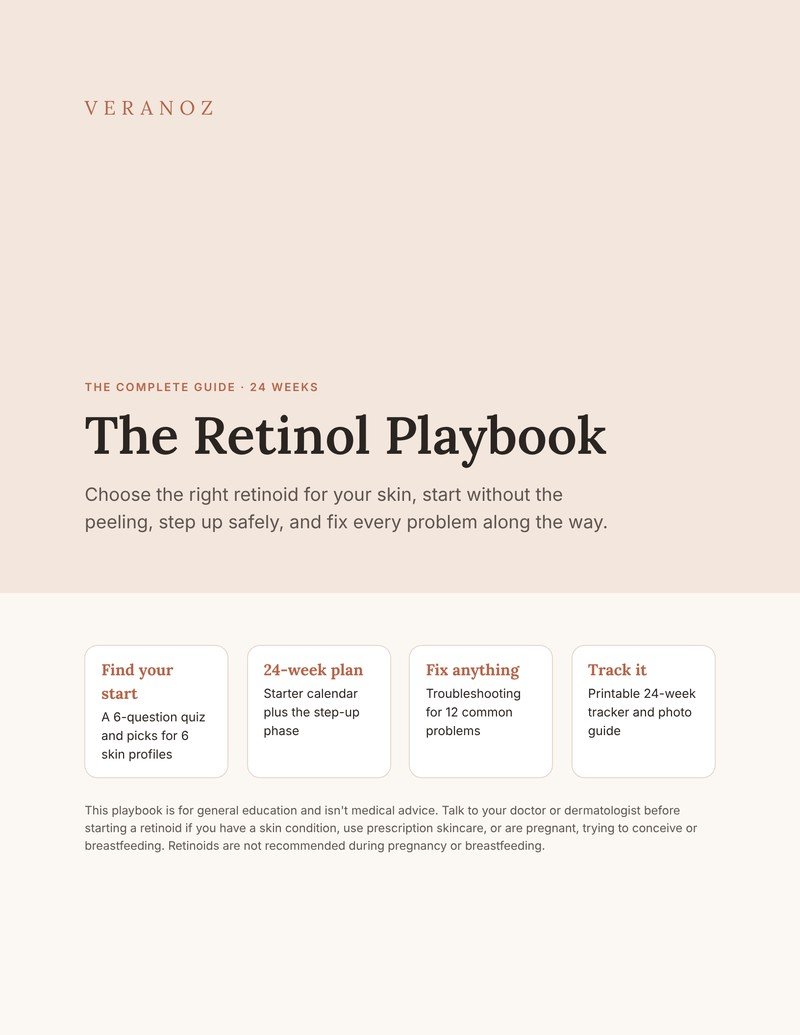
The Retinol After 40 Playbook
A skin-profile quiz with product picks, a 24-week calendar with step-up rules, fixes for 12 common problems, a pairing planner and a printable tracker. 23 pages, instant download.
See the Playbook ($29) →