

Disclosure: As an Amazon Associate, Veranoz earns from qualifying purchases. Some other links are affiliate links too. We may earn a commission at no extra cost to you. Veranoz hasn’t tested every product listed; picks are based on ingredient lists, brand information, dermatologist guidance and published retinoid research.
Most retinol before and after stories have an awkward middle: in the first few weeks, skin can look worse before it looks better. You started a retinol, and two weeks later your skin looks worse than when you began. Maybe there are new bumps on your chin. Maybe your cheeks are pink, tight and flaky, or your moisturizer suddenly stings. The internet will tell you it’s “purging” and to push through. Sometimes that’s true. Often it isn’t, and pushing through irritated skin is exactly how women over 40 end up quitting retinol for good. This guide shows you how to tell purging from irritation (and from a product that’s simply breaking you out), what each one looks like, how long it should last, and what to do the same night so you keep the benefits without wrecking your skin barrier.
Free: the 12-Week Retinol Starter Plan
Which retinoid to pick, a night-by-night 12-week ramp-up calendar, how to tell purging from irritation and a printable progress tracker.
Free. You will also get a few short emails with tips and offers. Unsubscribe anytime. Privacy policy.
The Real Problem
“Purging” and “irritation” both show up in the first few weeks, both look like your skin getting worse, and they need opposite responses. Purging usually means keep going at the same pace. Irritation means slow down or stop. Mature skin is drier and repairs its barrier more slowly, so after 40 most early retinol problems are irritation, not purging, and treating irritation like a purge makes it worse.
Short Answer
Likely purging: small whiteheads, blackheads or pimples in the places you usually break out, starting in weeks 2–6, clearing faster than your normal breakouts. What to do: keep the same schedule, don’t add anything new, and it should settle within about 4–6 weeks. Likely irritation: redness, stinging, burning, tightness, flaking, or a raw, shiny look, often within the first week, and tiny red bumps rather than real pimples. What to do: pause 3–7 nights, moisturize, then restart at a lower frequency. Stop and see a doctor for blistering, swelling, oozing, crusting or a rash that spreads past where you applied it. Don’t use retinoids if you’re pregnant, trying to conceive or breastfeeding.
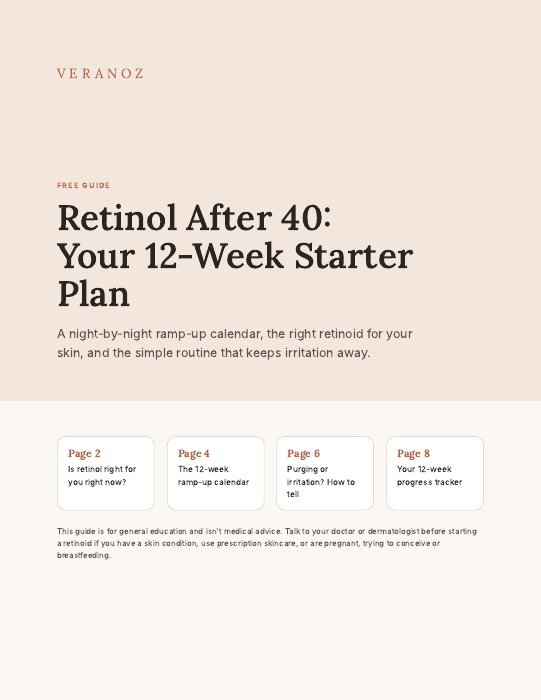
Retinol After 40: Your 12-Week Starter Plan
Which retinoid to pick, a night-by-night ramp-up calendar, purging vs irritation, and a printable tracker. Start retinol without the peeling.
Send me the free plan →In This Guide
- Why retinol can make skin look worse first
- What purging is (and why some dermatologists dislike the word)
- What retinol irritation looks like
- Purging vs irritation vs a bad product: side by side
- Week-by-week: what’s normal
- The 60-second check
- If it’s purging: what to do
- If it’s irritation: the reset plan
- Products that help you get through it
- How to prevent both next time
- Mistakes to avoid
- FAQ
Why Retinol Can Make Skin Look Worse First
Retinol is a form of vitamin A that skin converts, step by step, into retinoic acid, the form that actually switches on changes in skin cells. Two of those changes explain almost every early problem:
- Faster cell turnover. Retinoids speed up how quickly new cells move to the surface and old ones shed. That’s what smooths texture and fades spots over time, but it can also bring clogs that were already forming deeper in the pore to the surface sooner.
- A temporary dip in barrier comfort. While skin adjusts, the outer layer can lose more water and react more easily. That’s where dryness, flaking, redness and stinging come from.
This adjustment period is sometimes called “retinization.” Dermatology brand Galderma’s patient education describes it as skin getting “a little worse before it gets better,” typically between weeks 2 and 4, with side effects easing as you keep going.
How strong the reaction is depends heavily on the type of retinoid. In a study published in Dermatology (Fluhr and colleagues, 1999), retinol and retinaldehyde had a similarly low irritation potential in short-term testing, while prescription retinoic acid (tretinoin) was clearly more irritating. In the long-term part of the study, during the first 4 weeks retinoic acid caused redness in 44% of people, scaling in 35% and burning or itching in 29%, all significantly more often than retinaldehyde. Translation: over-the-counter retinol is gentler, but “gentler” isn’t “none,” especially on drier, thinner skin after 40.
What Purging Is (and Why Some Dermatologists Dislike the Word)
“Purging” describes a short-lived wave of breakouts after starting an ingredient that speeds up cell turnover. Dermatologist Dr. Whitney Bowe explains that it only happens with ingredients that increase turnover, such as retinoids, AHAs, BHAs, benzoyl peroxide and azelaic acid, and that it should appear in the areas where you normally break out, look like whiteheads and blackheads rather than tiny red bumps, and be temporary, about 4–6 weeks.
It’s worth knowing the term is debated. Dermatologists Dr. Shannon Humphrey and Dr. Aegean Chan have pointed out that “purging” isn’t a textbook term and became popular on social media. A literature review in the Journal of Drugs in Dermatology (Yentzer, McClain and Feldman, 2009) found no primary clinical trial data showing that topical retinoids make acne flare; the data pointed to improvement even in the first couple of weeks, and the authors suggested early worsening in some people reflects the natural ups and downs of acne.
So what does that mean for you? Two practical things:
- A small, short wave of breakouts in your usual spots after starting a retinoid is common enough that most dermatologists will tell you to stick with it.
- “It’s just purging” is not a reason to ignore redness, burning or bumps in new places. Those point to irritation or a reaction, and they don’t get better by pushing harder.
What Retinol Irritation Looks Like
Irritation (sometimes called retinoid dermatitis) is the skin reacting to too much retinoid, too often, or on a barrier that was already stressed. Common signs:
- Redness or pinkness, especially on cheeks, around the nose and mouth, and on the neck
- Stinging or burning when you apply your usual moisturizer, sunscreen or even water
- Tightness within an hour of washing
- Flaking or peeling, often worst around the nose, mouth corners and chin
- A shiny, “plastic,” almost raw look to the skin
- Tiny red, rough or itchy bumps (not pus-filled pimples)
According to Dr. Chan, irritation tends to show up faster than a purge, usually within about a week of starting. Singapore General Hospital’s patient guidance on topical retinoids lists peeling, redness and mild stinging as common early side effects and advises applying less often if irritation is bad, and seeing a doctor promptly for burning, blistering, crusting, itching or swelling.
Less commonly, the problem is an allergic reaction to an ingredient in the product (the retinoid, a fragrance or a preservative). That usually looks itchier, can spread beyond where you applied the product, and doesn’t settle when you cut back. That needs a dermatologist, not a slower schedule.
Purging vs Irritation vs a Bad Product: Side by Side
| Sign | Purging | Irritation | Product breaking you out or allergy |
|---|---|---|---|
| What you see | Whiteheads, blackheads, small pimples | Redness, flaking, dry patches, tiny red bumps | New clogged pores or an itchy, spreading rash |
| Where | Your usual breakout zones | Cheeks, around nose and mouth, neck, anywhere thin | New areas, or beyond where you applied it |
| How it feels | Like normal breakouts | Stinging, burning, tight, sore | Itchy, sometimes swollen |
| When it starts | Usually weeks 2–6 | Often within the first week, or after you increase frequency | Any time; often gets steadily worse |
| How long | Settles in about 4–6 weeks | Improves within days of slowing down | Keeps going until you stop the product |
| Ingredient | Only turnover ingredients (retinoids, acids) | Any strong active, or too many at once | Can be any ingredient, including “gentle” ones |
| What to do | Keep the same pace | Pause, repair, restart slower | Stop; see a dermatologist if it doesn’t clear |
Pro Tip
You can have both at once: a few purge-type spots on your chin plus irritated, flaky cheeks. Treat the irritation first. A calm barrier makes the breakouts settle faster too.
Week by Week: What’s Normal
| When | Normal | Not normal |
|---|---|---|
| Week 1 | Slight dryness or tightness the next morning | Stinging with moisturizer, visible redness, burning |
| Weeks 2–4 | Light flaking around the nose and mouth; a few breakouts in usual spots | Red, raw or shiny patches; bumps in new areas |
| Weeks 4–6 | Breakouts slowing down; texture starting to feel smoother | Redness that lasts into the next day, every day |
| Weeks 6–12 | Smoother texture, more even tone, few side effects | Still breaking out more than before you started |
| Any time | Mild dryness after increasing frequency | Blistering, swelling, oozing, crusting, a spreading rash |
Results take time either way. Galderma’s education material gives a 2–12 week range for seeing results with a retinoid, and for fine lines on mature skin you should judge at about 12 weeks, not day 12. Take a photo in the same light on day 1 so you can compare honestly.
The 60-Second Check
Answer these the morning after a retinoid night:
- Does plain moisturizer sting? Yes = irritation. Pause.
- Are the spots only where you usually break out? Yes = likely purging. No = irritation, clogging or a reaction.
- Are they whiteheads or blackheads, or tiny red rough bumps? Whiteheads and blackheads lean purging; tiny red bumps lean irritation.
- Is your skin red, tight or shiny? Yes = irritation, whatever else is going on.
- Is it itchy or spreading past where you applied it? Yes = possible allergy. Stop the product.
- Is it past week 6 and still getting worse? Yes = it’s not a purge. Reassess the product and the schedule.
Free: the 12-Week Retinol Starter Plan
Which retinoid to pick, a night-by-night 12-week ramp-up calendar, how to tell purging from irritation and a printable progress tracker.
Free. You will also get a few short emails with tips and offers. Unsubscribe anytime. Privacy policy.
If It’s Purging: What to Do
- Keep the same schedule. Don’t jump to nightly use to “get it over with,” and don’t stop and restart, which can drag the adjustment out.
- Don’t add new actives. No new acid toner, scrub or spot treatment on retinoid nights. One change at a time.
- Hands off. Picking turns small spots into dark marks that last months longer than the breakout.
- Keep moisturizing with a non-comedogenic moisturizer and wear SPF every morning.
- Set a deadline. If breakouts aren’t clearly settling by about week 6, or they’re spreading to new areas, it’s not purging. Switch formulas or ask a dermatologist.
Breakouts that started before retinol? Check the usual culprits in everyday skincare mistakes causing breakouts and whether stress is behind them.
If It’s Irritation: The Reset Plan
- Stop the retinoid for 3–7 nights. Stop any acids, scrubs, vitamin C serum and fragranced products too.
- Cleanse once a day at night with a gentle, non-foaming cleanser and lukewarm water. In the morning, a splash of water is enough.
- Moisturize generously with a fragrance-free cream that has ceramides, glycerin or panthenol. Apply it on slightly damp skin.
- Seal raw spots around the nose and mouth with a thin layer of petroleum jelly or a healing balm at night.
- Wear a gentle sunscreen every morning. Mineral formulas are often easier on irritated skin.
- Restart when moisturizer no longer stings, at a lower frequency: twice a week, using the moisturizer “sandwich” (moisturizer, then a pea-sized amount of retinoid, then moisturizer again).
- Build up slower than last time, adding one night a week only every two weeks, and only if skin stays comfortable.
For a deeper barrier rescue, see how to repair your skin barrier and how to calm irritated skin gently.
Pro Tip
Irritation that keeps coming back at the same step usually means the product is too strong for you right now. Drop to a gentler retinoid (a retinoid in a cream base, or one paired with niacinamide) rather than forcing a stronger one. Our list of the best retinols for sensitive skin covers the gentlest fragrance-free options. Or try a gentler alternative for a few months: see retinol vs bakuchiol and peptides vs retinol.
Products That Help You Get Through It
You don’t need a new routine to get through retinization. You need a gentle cleanser, a barrier-friendly moisturizer, something occlusive for raw spots and, if irritation keeps returning, a gentler retinoid. These are widely available, fragrance-free or low-fragrance options based on their ingredient lists.
Vanicream Gentle Facial Cleanser
A fragrance-free, low-foam cleanser designed for sensitive skin. It cleans without leaving skin tight, which is what you want while your barrier recovers.
Check on Amazon →CeraVe Hydrating Facial Cleanser
A non-foaming lotion cleanser with ceramides and hyaluronic acid. A reliable everyday cleanser to pair with a retinoid.
Check on Amazon →CeraVe Moisturizing Cream
A rich, fragrance-free cream with ceramides and hyaluronic acid. Thick enough to buffer a retinoid and calm tightness overnight.
Check on Amazon →La Roche-Posay Cicaplast Baume B5
A soothing balm with panthenol (vitamin B5) and madecassoside. Use a thin layer on irritated patches at night during your reset.
Check on Amazon →Aquaphor Healing Ointment
A petrolatum-based ointment that seals in moisture. A tiny dab where retinol tends to pool prevents a lot of flaking.
Check on Amazon →Olay Regenerist Retinol 24 Night Moisturizer
A retinoid complex with niacinamide in a moisturizer base, which makes it an easier entry point for dry, sensitive skin.
Check on Amazon →First Aid Beauty Skin Lab Retinol Serum 0.25%
A fragrance-free, low-strength retinol with colloidal oatmeal, allantoin and ceramides. A sensible choice if your first retinol left you red.
Check on Amazon →Quick Comparison
| Product | Role | When | Key ingredients |
|---|---|---|---|
| Vanicream Gentle Facial Cleanser | Cleanser | Nightly during a reset | Fragrance-free, low-foam |
| CeraVe Hydrating Facial Cleanser | Cleanser | Everyday | Ceramides, hyaluronic acid |
| CeraVe Moisturizing Cream | Moisturizer | Retinoid nights (sandwich) | Ceramides, hyaluronic acid |
| La Roche-Posay Cicaplast Baume B5 | Soothing balm | On raw patches at night | Panthenol, madecassoside |
| Aquaphor Healing Ointment | Occlusive | Nose and mouth corners | Petrolatum |
| Olay Regenerist Retinol 24 Night | Gentle retinoid | Restart, 2 nights a week | Retinoid complex, niacinamide |
| FAB Skin Lab Retinol Serum 0.25% | Gentle retinoid | Restart, 2 nights a week | Retinol, oat, allantoin, ceramides |
More picks by skin type are in our best moisturizers for women over 40 and best sunscreens for women over 40.
How to Prevent Both Next Time
- Start low and slow: a low-strength retinol two nights a week for the first two weeks, then add a night every two weeks only if skin is calm.
- Pea-sized means pea-sized for the whole face. More product doesn’t mean faster results, only more peeling.
- Apply to completely dry skin. Damp skin absorbs retinoids faster and irritates more easily.
- One strong active per night. No acids, scrubs or vitamin C serum on retinoid nights while you’re adjusting.
- Use the moisturizer sandwich if you’re dry or sensitive.
- Protect the creases with petroleum jelly before you apply.
- Wear SPF 30+ every morning. Retinoids make skin more sun-sensitive.
- Add one new product at a time, a few weeks apart, so you always know what caused a reaction.
- Go slower in winter and around menopause, when skin is drier.
Want this as a printable plan? Our free Retinol After 40 Starter Plan has a night-by-night 12-week calendar, a purging-vs-irritation table and a progress tracker.
Mistakes to Avoid
- Calling every reaction “purging” and pushing through redness and burning
- Increasing to nightly use to “speed up” a purge
- Adding a new acid, scrub or spot treatment while you’re adjusting
- Starting a retinoid and a new moisturizer in the same week
- Stopping and restarting every few days, so skin never adjusts
- Applying retinol right after a shower on damp skin
- Skipping sunscreen because it’s cloudy or you’re indoors
- Waiting past week 6 for a “purge” that’s still spreading
Purging vs Irritation Checklist
- Spots only in usual zones, weeks 2–6: keep going
- Stinging, redness, tight or shiny skin: pause 3–7 nights
- Tiny red bumps or new areas: irritation or clogging, not purging
- Itchy or spreading rash: stop the product
- Restart twice a week with the moisturizer sandwich
- No new actives while adjusting
- SPF 30+ every morning
- Still worse after week 6: change product or see a dermatologist
Frequently Asked Questions
How long does retinol purging last?
Dermatologists commonly describe it as settling within about 4–6 weeks. If breakouts keep coming or spreading after that, it’s more likely irritation, a clogging product or your usual acne.
Is retinol purging real?
It’s debated. Many dermatologists see a short, mild wave of breakouts in usual spots after starting a retinoid, but a 2009 review found no clinical trial data showing that topical retinoids make acne flare. Either way, redness, burning and bumps in new places are not purging.
How do I know if retinol is irritating my skin?
Stinging when you apply plain moisturizer, redness that lasts into the next day, tightness, flaking, a raw or shiny look, and tiny red rough bumps are the main signs.
Should I stop retinol if my skin is peeling?
Light flaking in the first weeks is common. Cut back to twice a week and moisturize more. If it’s red, raw or stinging, pause for 3–7 nights, then restart more slowly.
Can you purge from retinol if you don’t have acne?
You might see a few small spots where you occasionally break out, but if you rarely break out and suddenly have lots of bumps, think irritation or a product that doesn’t suit you.
Does purging happen with gentle retinol creams too?
It can, since any retinoid speeds up turnover, but gentler formulas and lower strengths usually cause milder reactions.
Can I use a spot treatment while purging?
Keep it minimal. A spot treatment on a single pimple on a non-retinoid night is fine, but layering acids or benzoyl peroxide over retinol often turns a purge into irritation.
When should I see a dermatologist?
For burning, blistering, swelling, oozing, crusting, a rash that spreads past where you applied the product, or breakouts that are still getting worse after 6 weeks.
Is retinol safe during pregnancy?
Retinoids aren’t recommended during pregnancy, while trying to conceive or while breastfeeding. Ask your doctor about alternatives.
Sources: Fluhr JW et al., “Tolerance profile of retinol, retinaldehyde and retinoic acid under maximized and long-term clinical conditions,” Dermatology, 1999; Yentzer BA, McClain RW, Feldman SR, “Do Topical Retinoids Cause Acne to ‘Flare’?” Journal of Drugs in Dermatology, 2009; Galderma, Retinoid education; Singapore General Hospital, Topical retinoid side effects; Dr. Whitney Bowe, purging or breaking out; dermatologists Dr. Shannon Humphrey and Dr. Aegean Chan in Montecristo; product information from each brand. Veranoz has not lab-tested every product listed. This article is informational and not medical advice.
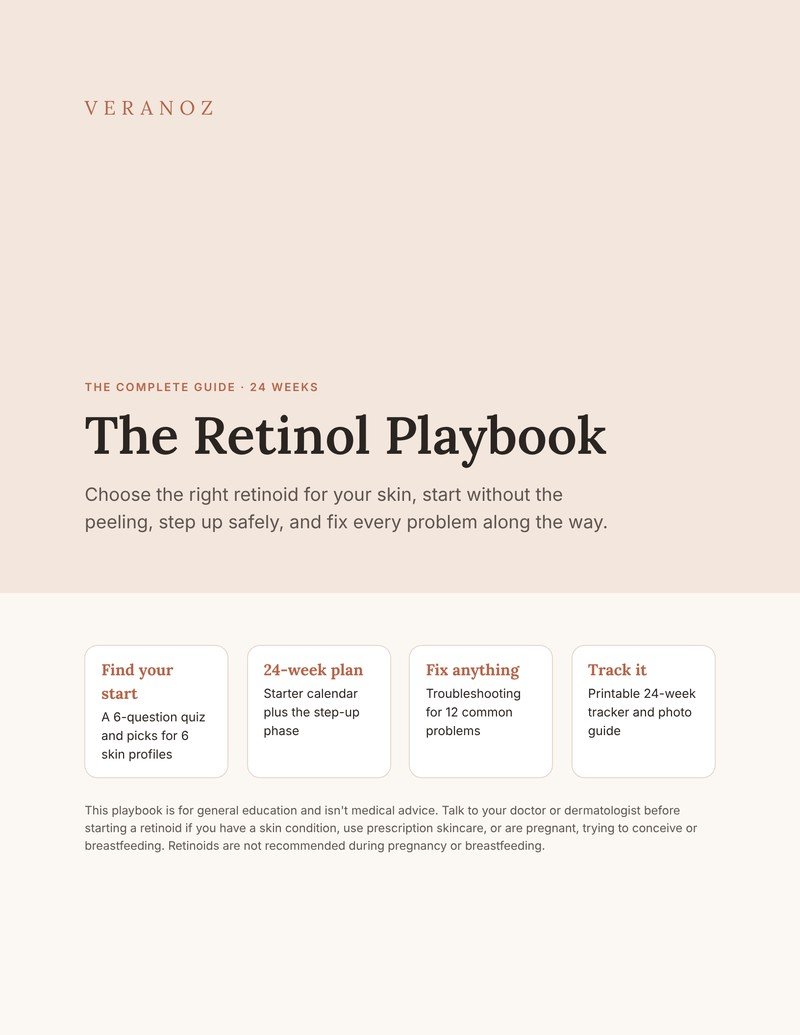
The Retinol After 40 Playbook
A skin-profile quiz with product picks, a 24-week calendar with step-up rules, fixes for 12 common problems, a pairing planner and a printable tracker. 23 pages, instant download.
See the Playbook ($29) →