

Disclosure: As an Amazon Associate, Veranoz earns from qualifying purchases. We may earn a commission if you buy through links in this post, at no extra cost to you.
The right skincare routine order is simple: in the morning, cleanser, then a serum, then moisturizer, then sunscreen as the very last skincare step before makeup. At night, cleanser, then your treatment (such as a retinoid), then moisturizer. In between, the rule for how to layer skincare is thinnest to thickest: watery products first, creams after, oils and balms last. Get that order right and your products work better, irritate less and sit smoothly under makeup.
Free: the Skincare Layering Cheat Sheet
The morning and night order, what not to mix, and how long to wait between steps, on one printable page.
Free. You will also get a few short emails with tips and offers. Unsubscribe anytime. Privacy policy.
Below you’ll find the full morning and night order, exactly where every product type goes (toner, vitamin C, eye cream, face oil and more), what not to layer together, how to keep skincare under makeup from pilling, and sample routines for dry, delicate skin.
The Real Problem
Over the years, most of us have collected a shelf of serums, creams and “must-haves,” and no clear idea which goes first. Apply a rich cream before a thin serum and the serum can’t reach your skin. Stack three strong actives and skin turns red and flaky. Rush sunscreen and foundation on top of each other and everything rolls into little balls. Skin also gets thinner and drier over time, as MedlinePlus explains, so it has less tolerance for the wrong combinations. The fix isn’t more products. It’s the right order and fewer layers.
Short Answer
Morning: cleanser → toner or essence (optional) → serum (vitamin C or hydrating) → eye cream (optional) → moisturizer → sunscreen SPF 30+ → makeup. Night: remove makeup and cleanse → toner (optional) → treatment (retinoid, exfoliating acid or prescription) → eye cream (optional) → moisturizer → face oil or occlusive (optional). Rules: thinnest to thickest, treatments on clean skin, sunscreen last in the morning, one strong active per routine.

The Skincare Layering Cheat Sheet
Not sure where this serum goes in your routine? Get the right order morning and night, a pairing chart (vitamin C, retinoids, acids, niacinamide) and ready-made routines for dry, delicate skin.
Send me the free cheat sheet →Want the whole routine built for your skin type? The Skincare Routine Builder has 8 routine blueprints, a 12-ingredient compatibility matrix, a 4-week on-ramp and rotation calendars. 28 pages, $24.
In This Guide
5 Rules for How to Layer Skincare
- Thinnest to thickest. Cleveland Clinic dermatologist Sean McGregor, DO, recommends layering from lightest to heaviest. A thick cream applied first keeps a thin serum from reaching the skin.
- Treatments go on clean skin. The AAD’s order puts medication or treatment right after cleansing, so active ingredients have direct contact with your skin. Moisturizer comes after.
- Sunscreen is the last skincare step in the morning. Then makeup. Cleveland Clinic notes that SPF in moisturizer or makeup is usually not enough on its own for full protection.
- Water-based before oil-based. Oils and balms form a film that slows what goes on top. Keep them for the end of the night routine.
- Fewer products, fewer problems. Dr. McGregor puts it simply: the more products you use, the better the chances of side effects. The AAD also warns that using too many products, especially more than one anti-aging product, can irritate skin.
Not sure whether something is “thin” or “thick”? Rub a drop between two fingers. If it’s watery or gel-like, it goes earlier. If it’s creamy, oily or leaves a film, it goes later.
Related: Skincare routine order made simple
Morning Skincare Routine Order
The morning routine is about protection: hydrate, defend with an antioxidant if you like, and finish with sunscreen.
| Step | Product | Why here | Optional? |
|---|---|---|---|
| 1 | Gentle cleanser (or a water rinse) | Removes overnight products and oil | Rinse is fine for dry skin |
| 2 | Toner or essence | Watery layer; hydrating formulas add water | Yes |
| 3 | Serum (vitamin C, niacinamide or hydrating) | Thin, concentrated, needs skin contact | Yes, but recommended |
| 4 | Eye cream | Between serum and moisturizer | Yes |
| 5 | Moisturizer | Seals in water; slows water loss | Sometimes replaced by a moisturizing sunscreen |
| 6 | Sunscreen, broad-spectrum SPF 30+ | Must be the top skincare layer to protect evenly | No |
| 7 | Makeup | Goes on after skincare has settled | Yes |
The AAD recommends a broad-spectrum, water-resistant sunscreen with SPF 30 or higher, applied before you go outdoors and reapplied every two hours when you’re outside. For a deeper look at why the two routines differ, see morning vs evening skincare.
Night Skincare Routine Order
The night routine is about repair and treatment: clean thoroughly, apply your strongest active, then cushion it.
| Step | Product | Why here | Optional? |
|---|---|---|---|
| 1 | Makeup remover or cleansing balm | Breaks down sunscreen and long-wear makeup | Only if you wore makeup or water-resistant SPF |
| 2 | Gentle cleanser | Clean skin so treatments can work | No |
| 3 | Toner or hydrating essence | Optional watery layer | Yes |
| 4 | Treatment: retinoid, exfoliating acid or prescription | Actives work best on clean skin | Yes |
| 5 | Eye cream | After treatment, before moisturizer | Yes |
| 6 | Moisturizer or night cream | Replenishes and reduces dryness from actives | No |
| 7 | Face oil or occlusive balm | Heaviest layer; seals everything in | Yes, for dry skin |
Retinoids belong at night: Cleveland Clinic explains they can break down and irritate skin in sunlight, and a pea-sized amount is enough for the whole face. Skip retinoids if pregnant, trying to conceive or breastfeeding. If you’re starting one, our retinol beginner routine shows how to build up slowly.
Related ReadNight Cream vs RetinolWhere Every Product Goes
Here’s how to layer skincare when you have more than the basics.
| Product | Where it goes | AM, PM or both | Notes |
|---|---|---|---|
| Micellar water / cleansing balm | First, before cleanser | PM | For makeup and water-resistant sunscreen |
| Toner | Right after cleansing | Either | Dr. McGregor notes some toners can be drying; hydrating, alcohol-free formulas are gentler |
| Essence | After toner, before serum | Either | A watery hydrating layer; optional |
| Vitamin C serum | After cleansing/toner | AM | Supports sunscreen but doesn’t replace it |
| Hyaluronic acid serum | On damp skin, before moisturizer | Both | Seal with moisturizer so it doesn’t leave skin feeling drier |
| Niacinamide serum | Serum step | Either | Usually layers easily with other products |
| Exfoliating acids (AHA/BHA) | Treatment step on clean skin | PM | A couple of times a week; not the same night as a retinoid if you’re sensitive |
| Retinoid | Treatment step on clean skin | PM | Pea-sized amount; skip if pregnant, trying to conceive or breastfeeding |
| Spot treatment | Serum/treatment step | Either | Cleveland Clinic notes some increase sun sensitivity; wear sunscreen |
| Eye cream | After serum, before moisturizer | Both | The AAD suggests dabbing it on with your ring finger |
| Moisturizer | After serums and treatments | Both | Lighter in the morning, richer at night |
| Face oil | After moisturizer at night | PM | Mostly for dry skin; can make makeup slide in the morning |
| Sleeping mask / occlusive | Very last at night | PM | Thin layer on dry areas |
| Sunscreen | Last skincare step | AM | Before makeup; reapply outdoors |
Face oil placement is debated. Some people use it before moisturizer, others after. The thinnest-to-thickest rule suggests last at night, where it acts as a seal and can’t block your treatment. Cleveland Clinic’s Dr. McGregor generally doesn’t recommend face oils unless skin is dry.
How Long to Wait Between Steps
There’s no exact, research-backed number for every step, and Cleveland Clinic’s guidance doesn’t set fixed wait times. What matters is that each layer has spread and isn’t sliding around when you apply the next one.
- Between watery layers (toner, essence, hydrating serum): no real wait; press each in and move on.
- Before moisturizer: until the serum no longer feels wet, usually under a minute.
- After a retinoid: many people wait a few minutes for it to absorb before moisturizer, or apply moisturizer first and the retinoid on top to buffer it if skin is sensitive.
- Before makeup: give sunscreen several minutes to settle. The AAD notes it takes about 15 minutes for skin to absorb sunscreen before you head outdoors, so apply it early in your routine if you’re leaving right after.
What Not to Layer Together
Most products layer fine. A few combinations are better split between morning and night, or alternated on different nights, especially on dry, delicate skin.
| Combination | Why to separate | How to use both |
|---|---|---|
| Retinoid + exfoliating acid | Both can irritate and dry skin; together, more so | Alternate nights, or use the acid only once or twice a week |
| Vitamin C + AHA | Cleveland Clinic notes mixing them can disrupt the skin’s pH | Vitamin C in the morning, AHA at night |
| Several serums at once | More layers, more irritation, more pilling | Dr. McGregor recommends one serum at a time |
| Two anti-aging actives | The AAD warns multiple anti-aging products can irritate | Pick one active per routine |
| Scrubs + retinoid | Physical exfoliation on top of a retinoid can cause raw, flaky skin | Pause scrubs while starting a retinoid |
If you’d like a structured way to rotate actives, our guide to skin cycling for beginners lays out a simple four-night plan.
Related ReadHow Often Should You Exfoliate Face Skin?Free: the Skincare Layering Cheat Sheet
The morning and night order, what not to mix, and how long to wait between steps, on one printable page.
Free. You will also get a few short emails with tips and offers. Unsubscribe anytime. Privacy policy.
Skincare Under Makeup Without Pilling
Pilling, those tiny rolled-up flakes when you apply foundation, almost always comes from too much product, not enough time, or rubbing. Here’s how to layer skincare under makeup so it stays smooth.
- Keep the morning routine short. Cleanser, one serum, moisturizer, sunscreen. Save treatments and oils for night.
- Use less than you think. A pea-sized amount of serum and a small amount of moisturizer, especially in the T-zone.
- Press, don’t rub. Press each layer in with your palms. Rubbing lifts the layer underneath.
- Let sunscreen settle for several minutes before base. Do your hair or make coffee.
- Tap makeup on. Use a damp sponge or fingertips in tapping motions instead of sweeping foundation across the skin.
- Skip primer at first. If you pill, remove primer for a few days to see if it’s the culprit. Every extra layer changes how the others behave.
- Change one product at a time. Some sunscreen and foundation combinations simply don’t get along; swapping one at a time shows you which.
If makeup still slides or rolls, lift away the flakes with a clean brush or tissue and touch up with a very small amount of product. Adding more product on top usually makes it worse. Once your skin prep is sorted, our everyday makeup routine shows what goes on top, in order.
Related ReadBest Daily Face SunscreenSample Skincare Routines for Dry, Delicate Skin
The minimalist (3 steps)
- AM: gentle cleanser or rinse → moisturizer → sunscreen SPF 30+
- PM: gentle cleanser → moisturizer
The anti-aging basics
- AM: gentle cleanser → vitamin C serum → moisturizer → sunscreen
- PM: cleanser → retinoid (2 to 3 nights a week to start, then more as tolerated) → moisturizer. Skip retinoids if pregnant, trying to conceive or breastfeeding.
Dry or dehydrated skin
- AM: water rinse → hydrating serum on damp skin → cream moisturizer → moisturizing sunscreen
- PM: cream cleanser → hydrating serum → treatment a few nights a week → rich cream → thin occlusive on dry patches
Our hydrating skincare routine goes deeper on dehydrated skin.
Oily or combination skin
- AM: gentle gel cleanser → niacinamide or hydrating serum → light gel moisturizer → lightweight sunscreen
- PM: cleanser → BHA two or three nights a week, retinoid on other nights → light moisturizer
Sensitive skin
- AM: rinse → fragrance-free moisturizer → mineral sunscreen
- PM: gentle cleanser → fragrance-free moisturizer; add one active only after skin is calm, and patch test first
Skincare Layering Mistakes to Avoid
| Mistake | What happens | Fix |
|---|---|---|
| Moisturizer before serum | The serum can’t reach the skin well | Thinnest to thickest |
| Sunscreen under moisturizer | Sunscreen film gets disturbed; uneven protection | Sunscreen last, then makeup |
| Retinoid in the morning | Can break down and irritate in sunlight | Retinoids at night only |
| Three or more serums | Irritation, pilling, wasted product | One serum per routine |
| Retinoid + acid + scrub the same night | Red, raw, flaky skin | One active per night |
| Face oil before makeup | Makeup slides and separates | Oils at night |
| Relying on SPF in makeup | Too little product for real protection | Separate sunscreen under makeup |
| Adding everything new at once | Can’t tell what’s helping or irritating | One new product every two weeks |
Products Worth Having for a Layered Routine
A complete routine needs only a handful of product types. Choose formulas you’ll actually use every day.
Gentle Face Cleanser
A mild cleanser that doesn’t leave skin tight is the base of any skincare routine order.
Check on Amazon →Vitamin C Serum
Use it in the morning under moisturizer and sunscreen. It supports sunscreen but never replaces it.
Check on Amazon →Retinol Serum for Beginners
Start with a low-strength formula two or three nights a week, pea-sized amount, followed by moisturizer.
Check on Amazon →Lightweight Daytime Moisturizer
A lotion or gel-cream absorbs quickly so sunscreen and makeup don’t pill.
Check on Amazon →Broad-Spectrum Face Sunscreen SPF 30+
Choose a texture you enjoy wearing under makeup, so you use enough every day.
Check on Amazon →Rich Night Cream
A cream with ceramides or squalane cushions treatments and helps skin recover overnight.
Check on Amazon →Skincare Routine Order Checklist
- Thinnest to thickest: water, serum, cream, oil
- AM: cleanser, serum, moisturizer, sunscreen, then makeup
- PM: cleanse, treatment, moisturizer, optional oil or balm
- Treatments on clean skin, right after cleansing
- Retinoids at night only, pea-sized amount
- Skip retinoids if pregnant, trying to conceive or breastfeeding
- One serum and one strong active per routine
- Vitamin C in the morning, acids at night
- Press layers in; let sunscreen settle before makeup
- Add one new product every two weeks
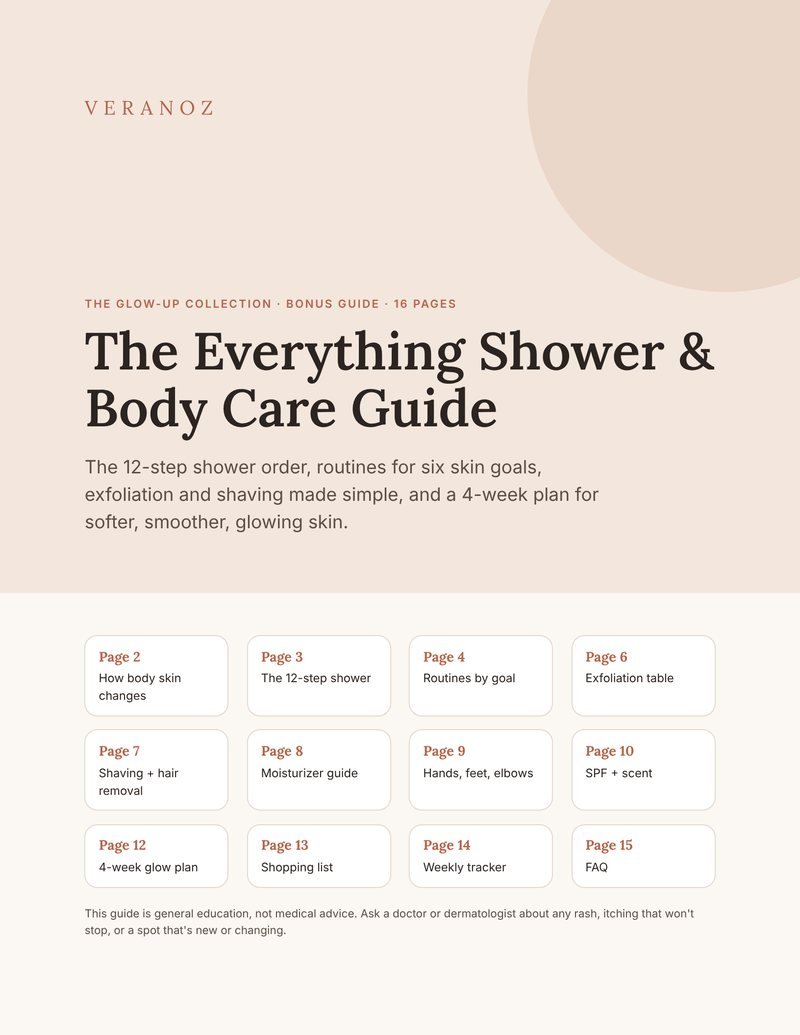
The Everything Shower & Body Care Guide
The 12-step shower order, routines for dry, crepey, bumpy or breakout-prone body skin, exfoliation and moisturizer guides, hands, feet and body SPF, and a 4-week body glow plan. 16 printable pages, instant access.
Get the Guide ($17) →Frequently Asked Questions
What is the correct skincare routine order?
Morning: cleanser, serum, moisturizer, sunscreen. Night: cleanser, treatment (such as a retinoid), moisturizer. Optional steps like toner, eye cream and face oil fit in by texture, thinnest to thickest.
Does serum or moisturizer go first?
Serum first. It’s thinner and more concentrated, so it needs direct contact with your skin. Moisturizer goes on top to seal it in.
Where does sunscreen go in a skincare routine?
Last in your morning skincare, after moisturizer and before makeup. Use broad-spectrum SPF 30 or higher and reapply every two hours outdoors.
Do I apply retinol before or after moisturizer?
Usually before, on clean, dry skin, followed by moisturizer. If your skin is sensitive, you can apply moisturizer first to buffer it. Skip retinoids if pregnant, trying to conceive or breastfeeding.
Where does eye cream go?
After serum and before moisturizer. Dab it on gently with your ring finger, as the AAD suggests.
Why does my skincare pill under makeup?
Usually too much product, not enough time between layers, rubbing instead of pressing, or a sunscreen and foundation that don’t get along. Use less, press layers in, wait a few minutes and change one product at a time.
How many skincare products should I use?
As few as you need. Cleanser, moisturizer and sunscreen are the core; add one serum and one treatment if you want them. More products raise the chance of irritation.
Sources: American Academy of Dermatology, Should I apply my skin care products in a certain order?; Cleveland Clinic, The right order to apply skin care products; American Academy of Dermatology, How to apply sunscreen; Harvard Health Publishing, Moisturizers: Do they work?; MedlinePlus (NIH), Aging changes in skin. Veranoz has not tested every product listed. This guide is general information; see a board-certified dermatologist for irritation, prescription treatments or persistent skin concerns.
Get the Free Self-Care Reset Kit
Daily, weekly and monthly self-care checklists, the everything shower order, a 3-hour at-home spa day plan and a 30-day reset tracker. Free printable, instant access.
The Veranoz 30-Day Glow-Up Planner
Routines only work when you actually keep them. The planner gives you daily planning pages, weekly resets and habit trackers so your skincare, body care and self-care steps become automatic instead of something you remember once in a while.
Veranoz Guides to Go Deeper
Some links on Veranoz are affiliate links; we may earn a commission at no extra cost to you. This content is informational and not medical advice.