

Disclosure: As an Amazon Associate, Veranoz earns from qualifying purchases. We may earn a commission if you buy through links in this post, at no extra cost to you.
The best morning routine ideas for women over 40 are the ones you can repeat on a Tuesday when you’re tired: wake up at the same time, drink a glass of water, move for a few minutes, do a short skin care routine that ends with broad-spectrum SPF 30+, eat something real, and pick your top three priorities before you open email. That’s a complete morning self care routine in about 20 minutes. Everything else, from journaling to a facial massage, is a bonus you add when you have the time.
Free: the Winter Dry Skin Rescue Plan
A printable 14-day plan for dry, tight winter skin: shower rules, a face routine, and fixes for hands, lips and heels.
Free. You will also get a few short emails with tips and offers. Unsubscribe anytime. Privacy policy.
This guide gives you a step-by-step morning skin care routine for mature skin, morning self care ideas beyond skin care, routines for 5, 15, 30 and 60 minutes, fixes for puffy eyes, dull skin and rushed mornings, what to prep the night before, and a printable-style morning routine checklist.
The Real Problem
Most mornings start with an alarm, a phone full of notifications, and a race to get out the door. Skin care gets reduced to “whatever is closest,” sunscreen gets skipped, and breakfast is coffee in the car. After 40, that shows: skin looks drier and duller, makeup sits on top instead of melting in, and you feel behind before the day has started. The fix isn’t waking up at 5 a.m. It’s a short, fixed sequence you can do half-awake, with a few minutes for yourself built in.

Short Answer: A 20-Minute Morning Routine
Minute 0 to 3: get up at your usual time, open the curtains, drink a glass of water. 3 to 8: stretch or walk. 8 to 15: skin care: gentle cleanse or rinse, antioxidant or hydrating serum, moisturizer, then broad-spectrum SPF 30+ on face, neck and the backs of your hands, plus SPF lip balm. 15 to 20: breakfast and a quick plan: three priorities for the day. Leave the phone face down until you’ve done at least the first two steps.
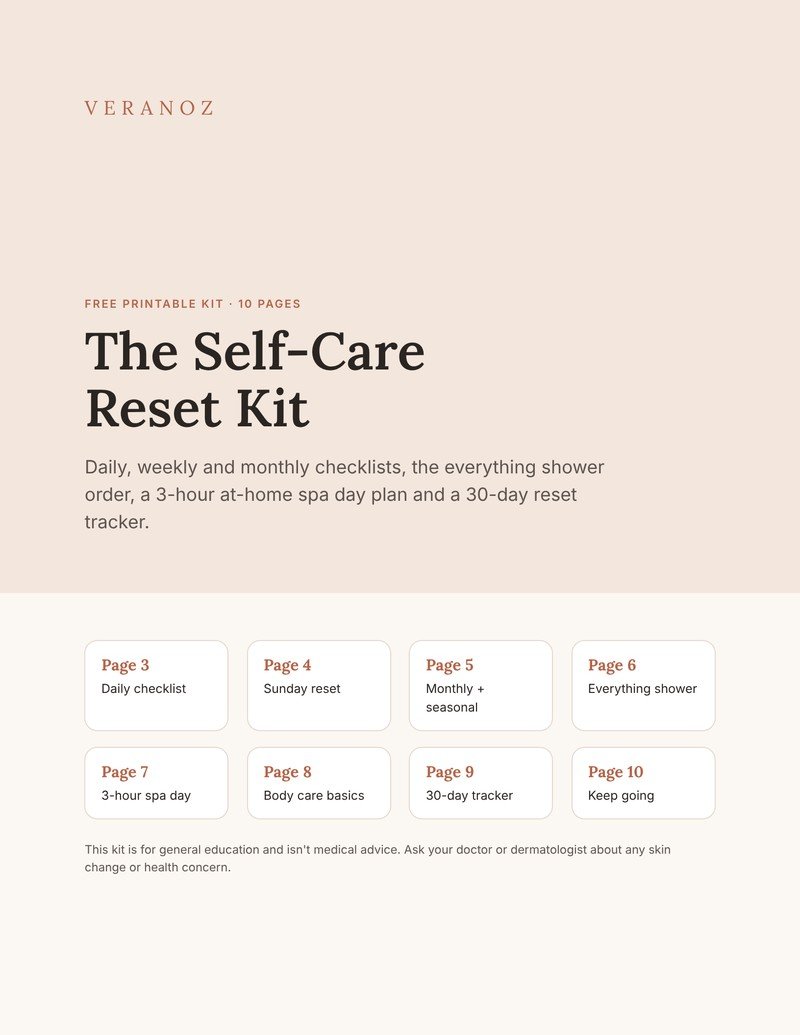
The Self-Care Reset Kit
Daily, weekly and monthly self-care checklists, the everything shower order, a 3-hour at-home spa day plan and a 30-day reset tracker.
Send me the free kit →In This Guide
- Why your morning routine matters more after 40
- The 20-minute morning routine
- Morning skin care routine for mature skin
- Morning self care routine ideas
- Morning routine ideas by time available
- Morning fixes: puffy eyes, dull skin, rushed days
- What to do the night before
- Products that make mornings easier
- Morning routine mistakes
- Morning routine checklist
- FAQ
Why Your Morning Routine Matters More After 40
A morning routine does two jobs. It protects your skin for the day ahead, and it sets your mood and energy before the demands start. Both get more important with age.
Skin needs more protection. MedlinePlus explains that as skin ages, the outer layer thins, skin becomes drier because oil glands produce less oil, and sun exposure is the single biggest factor in visible skin aging. That makes the morning steps, moisturizer and sunscreen in particular, the most valuable minutes of your whole skin care routine. The American Academy of Dermatology lists daily sun protection as the first of its 11 ways to reduce premature skin aging.
Your body likes a steady rhythm. The CDC recommends going to bed and getting up at the same time each day, including weekends, as one of its core healthy sleep habits. A fixed wake time anchors everything else. When the morning starts at the same time, it’s much easier to build a sequence that runs on autopilot.
Habits stick when they’re tied to a cue. In a well-known habit study by researchers at University College London, people tied a new daily behavior to an existing cue, like “after morning coffee.” On average, it took 66 days for the new behavior to feel automatic, and missing a single day made little difference. Mornings are full of cues you already have: the alarm, the kettle, brushing your teeth. Hook new habits onto those.
Pick your “start cue” and protect it. For many women it’s the first cup of coffee or tea. Nothing digital happens until that cup is finished: no email, no news, no social media.
The 20-Minute Morning Routine
Here’s the full routine in order. It’s designed for a weekday and works whether you leave the house or work from home.
| Time | Step | Why it helps |
|---|---|---|
| 0 to 3 min | Get up at your usual time, open the curtains, drink a glass of water | A steady wake time supports sleep; water starts your daily fluid intake |
| 3 to 8 min | Stretch, walk around the block, or do a few strength or balance moves | Counts toward the 150 weekly minutes of activity adults are advised to get |
| 8 to 15 min | Skin care: cleanse or rinse, serum, moisturizer, SPF 30+, lip balm | Hydrates and protects skin from daily UV exposure |
| 15 to 18 min | Breakfast with some protein and fruit | Regular, balanced meals are part of NIMH’s self care basics |
| 18 to 20 min | Write three priorities for the day | Separating “now” from “later” reduces overwhelm |
Getting enough fluids matters for how you feel, but don’t expect water to replace moisturizer. Mayo Clinic notes that fluid needs vary and that pale yellow urine and rarely feeling thirsty are signs you’re drinking enough; coffee, tea and water-rich foods all count toward your total.
Morning Skin Care Routine for Mature Skin
A morning skin care routine over 40 should be short, gentle and protective. Save stronger treatments, like retinoids and exfoliating acids, for the evening. Here are the steps in order.
1. Cleanse gently (or just rinse)
The AAD recommends washing your face when you wake up, before bed and after heavy sweating, using a gentle, non-abrasive cleanser, lukewarm water and your fingertips, then patting dry with a soft towel. If your skin is dry and you cleansed thoroughly the night before, a lukewarm water rinse is often enough in the morning.
2. Antioxidant serum (optional, but useful)
Vitamin C is the classic morning serum. A review in the Journal of Clinical and Aesthetic Dermatology describes topical vitamin C as an antioxidant that helps neutralize free radicals, supports collagen and may help with uneven pigmentation, and notes that sunscreen only partly blocks UV-generated free radicals. The same review says useful concentrations of L-ascorbic acid usually fall between 10 and 20 percent, and that this form of vitamin C is unstable. The practical takeaway: choose opaque, air-tight packaging, keep the cap closed, and replace a serum that has turned dark orange or brown. If vitamin C stings, try niacinamide instead: Cleveland Clinic describes it as generally gentle, helpful for redness, uneven tone and the look of fine lines, and easy to combine with other ingredients.
3. Hydrating serum on damp skin
Harvard Health recommends applying hyaluronic acid serum to skin that is still damp after cleansing, then following immediately with a moisturizer to seal in the water. It notes that most people can expect modest results: a little more fullness and less dryness, often within about a week. If you use a separate L-ascorbic acid serum, Harvard suggests applying it before hyaluronic acid.
4. Eye area
An eye cream is optional; your regular moisturizer, patted gently along the orbital bone, works for many women. Whatever you use, tap with your ring finger rather than rubbing. Our guide to whether eye cream is worth it over 40 explains when a dedicated formula helps.
5. Moisturizer
The AAD advises applying a facial moisturizer every day, because moisturizers trap water in the skin and give it a more youthful appearance. Choose a cream if your skin is dry, a lotion or gel-cream if it’s oily or combination. Include your neck and chest. See our picks for the best moisturizer for women over 40.
6. Sunscreen, every morning
Use a broad-spectrum, water-resistant sunscreen with SPF 30 or higher. The AAD says most adults need about one teaspoon for the face, roughly the length of your index and middle fingers, applied about 15 minutes before going outside, and reapplied every two hours outdoors or after sweating. It also notes that tinted sunscreens with iron oxide may help protect against dark spots caused by visible light, a useful option if you have melasma or sun spots. Don’t forget your ears, neck, the backs of your hands, and your lips with an SPF 30+ lip balm. More in our guide to the best sunscreen for women over 40.
| Skin type | Morning routine |
|---|---|
| Dry or mature | Water rinse or cream cleanser, hyaluronic acid on damp skin, rich cream, SPF 30+ |
| Oily or combination | Gentle gel cleanser, niacinamide serum, light gel-cream, SPF 30+ with a matte finish |
| Sensitive | Rinse or very mild cleanser, fragrance-free moisturizer, mineral SPF 30+ |
| Dark spots or melasma | Gentle cleanser, vitamin C or niacinamide, moisturizer, tinted SPF 30+ with iron oxide |
If you wear makeup, give sunscreen a few minutes to set, and press rather than rub foundation over it. Our guide to layering skincare under makeup explains the order, and morning vs evening skincare covers which ingredients belong at which time of day. If you use a retinoid, keep it for night; skip retinoids if pregnant, trying to conceive or breastfeeding.
Related ReadA Simple Morning Skincare Routine That WorksMorning Self Care Routine Ideas
Skin care is only part of a good morning. These morning self care ideas take one to ten minutes each. Choose two or three, not all of them.
- Open the curtains and step outside. Even five minutes on a porch or balcony with your coffee is a calmer start than scrolling.
- Delay your phone. Leave it on the charger in another room until you’ve finished your first cup.
- Stretch for five minutes. Neck rolls, shoulder circles, a hamstring stretch and a gentle twist.
- Walk before work. Ten minutes counts. NIMH notes that walking about 30 minutes a day can improve mood and health, and shorter sessions add up.
- Do balance work while you brush your teeth. Stand on one foot, then switch. Balance training is part of the activity guidelines for older adults.
- Try two minutes of slow breathing. Mayo Clinic describes breathing and relaxation techniques as skills that get easier with practice.
- Write three lines in a journal. One thing you’re looking forward to, one thing you’re grateful for, one thing you’ll let go of.
- Plan your top three. NIMH suggests separating what needs to happen now from what can wait.
- Eat breakfast sitting down. Even five minutes at the table is better than eating in the car.
- Make your bed. A tiny win that makes the bedroom calmer when you come back to it.
- Put on something that makes you feel good. Lay it out the night before so there’s no decision to make.
- Send one kind message. The CDC links social connection with better stress management and better sleep.
- Use a scent you love. A spritz of perfume or a scented body cream makes the routine feel like yours. See our fragrance layering routine.
- Listen to music instead of the news while you get ready.
For more ideas on building the habit side, see how to build a self care routine and daily beauty habits for confidence.
Morning Routine Ideas by Time Available
| Time | What to do |
|---|---|
| 5 minutes | Glass of water, moisturizer with SPF 30+, lip balm with SPF, three deep breaths, write one priority |
| 15 minutes | Water, five-minute stretch, rinse or gentle cleanse, serum, moisturizer, sunscreen, quick breakfast |
| 30 minutes | Water, 10-minute walk, full skin care routine, simple makeup, breakfast at the table, three priorities |
| 60 minutes | Water, 20 to 30 minutes of exercise, shower, full skin care, gentle face massage, makeup and hair, breakfast, journaling |
Most women do best with a 15- or 30-minute routine on weekdays and a slower 60-minute version on weekends. For more ideas, see skincare routine examples for busy days.
Morning Fixes: Puffy Eyes, Dull Skin, Rushed Days
Puffy eyes
Mayo Clinic suggests pressing a clean washcloth dampened with cool water gently under and around the eyes for a few minutes while sitting up. To prevent morning puffiness, it recommends sleeping with your head slightly raised, limiting salt, cutting down on fluids right before bed, and getting enough sleep. If puffiness comes with itching, allergies may be the cause.
Dull, tired-looking skin
Dullness after 40 is often a mix of dehydration, dead skin buildup and short sleep. Apply a hydrating serum on damp skin and seal with moisturizer, keep exfoliation for the evening one to three times a week, and protect your sleep. In a study published in the BMJ, researchers at Karolinska Institutet found that the same people were rated as looking less healthy, more tired and less attractive after sleep deprivation than after normal sleep. Our guides to refreshing dull skin naturally and glowing skin tips go deeper.
Dry, tight skin
Skip the morning cleanser and rinse with lukewarm water, use a cream instead of a lotion, and apply moisturizer within a minute of washing. A bedroom humidifier helps in heated months.
Workout mornings
The AAD recommends washing as soon as possible after heavy sweating. Exercise first, then do your full skin care routine after you shower, so sunscreen doesn’t sweat off before you leave.
Rushed mornings
Use a moisturizer with SPF 30+ to combine two steps, keep a tinted SPF and a cream blush in your bag, and drink water on the way. A five-minute routine done every day beats a perfect routine done twice a week.
Keep a “mini kit” by the door: SPF lip balm, hand cream with SPF, a cream blush and a folding brush. Even on chaotic mornings, you can finish your routine at a red light or in the parking lot.
Free: the Winter Dry Skin Rescue Plan
A printable 14-day plan for dry, tight winter skin: shower rules, a face routine, and fixes for hands, lips and heels.
Free. You will also get a few short emails with tips and offers. Unsubscribe anytime. Privacy policy.
What to Do the Night Before
The easiest mornings are planned the evening before. Five minutes at night saves twenty in the morning.
- Lay out clothes, including shoes and jewelry.
- Prep breakfast: overnight oats, boiled eggs, or fruit and yogurt ready to grab.
- Fill your water bottle and put it by the coffee maker.
- Line up your skin care on the counter in the order you use it.
- Charge your phone outside the bedroom. The CDC recommends putting devices away at least 30 minutes before bed.
- Write tomorrow’s top three so they’re out of your head.
- Go to bed at a consistent time. The CDC recommends 7 or more hours for adults up to 60 and 7 to 9 hours for ages 61 to 64.
Our evening self care routine walks through a full wind-down that sets up an easier morning.
Related ReadBeauty Routine Checklist for Easier MorningsProducts That Make Mornings Easier
These are product types, not specific brands. Choose fragrance-free options if your skin is sensitive.
Moisturizer With Broad-Spectrum SPF 30+
Combines two steps into one. Use a full teaspoon for face and neck so you actually get the SPF on the label.
Check on Amazon →Vitamin C Serum in Opaque Packaging
Look for L-ascorbic acid around 10 to 20 percent in an air-tight, opaque bottle, or a gentler derivative for sensitive skin. Apply before moisturizer and sunscreen. Our guide to the best serum for glowing skin compares options.
Check on Amazon →Hyaluronic Acid Serum
Apply to damp skin and seal right away with cream. Simple, fragrance-free formulas are best for daily use.
Check on Amazon →Tinted Mineral Sunscreen
Tinted formulas with iron oxide add visible-light protection and can replace a light foundation on busy days.
Check on Amazon →Cooling Eye Gel or Reusable Eye Mask
Keep it in the fridge and use it for a few minutes while you drink your coffee.
Check on Amazon →Sunrise Alarm Clock
Gradually brightens before your alarm sounds, which many people find a gentler way to wake at the same time every day.
Check on Amazon →SPF 30+ Lip Balm
Lips burn and dry out easily. Keep one by the sink and one in your bag, and reapply every two hours outdoors.
Check on Amazon →Morning Routine Mistakes
- Starting with your phone. Email and news put you in reaction mode before you’ve done anything for yourself.
- Skipping sunscreen on cloudy or “indoor” days. It’s the step with the biggest long-term payoff for skin.
- Using too little sunscreen. A thin layer doesn’t give you the SPF on the label. Aim for about a teaspoon for the face.
- Exfoliating or using strong acids in the morning. Keep those for the evening, and stop any product that stings or burns, as the AAD advises.
- Scrubbing with a washcloth. The AAD recommends cleansing with your fingertips; washcloths and scrubbing can irritate skin.
- Hot water. Lukewarm is kinder to drier skin.
- Copying a two-hour routine. A routine you can’t keep doesn’t help. Choose the version that fits your real mornings.
- Changing everything at once. Add one new habit at a time and give it a few weeks.
Morning Routine Checklist
Self Care
- Up at my usual time; curtains open
- Glass of water
- Five or more minutes of movement
- Phone off until my first cup is finished
- Two minutes of breathing or journaling
- Breakfast sitting down
- Three priorities written
Skin Care
- Gentle cleanse or lukewarm rinse
- Vitamin C or niacinamide serum (optional)
- Hydrating serum on damp skin
- Eye cream or moisturizer patted on gently
- Moisturizer on face, neck and chest
- Broad-spectrum SPF 30+, about one teaspoon, plus ears, neck and hands
- SPF 30+ lip balm
Night Before
- Clothes laid out
- Breakfast prepped, water bottle filled
- Phone charging outside the bedroom
- Bed at a consistent time
Frequently Asked Questions
What are some good morning routine ideas?
Wake at the same time, drink water, move for five to ten minutes, do a short skin care routine with SPF 30+, eat breakfast sitting down, and write three priorities. Add journaling, a walk outside, or a few minutes of slow breathing if you have more time.
What is a good morning self care routine for women over 40?
A 15- to 30-minute routine that covers movement, hydration, gentle skin care and a calm start: water, a short walk or stretch, cleanse or rinse, serum, moisturizer, sunscreen, breakfast and a quick plan for the day, all before you check email.
What is the correct order for a morning skin care routine?
Cleanse or rinse, antioxidant serum such as vitamin C, hydrating serum on damp skin, eye cream if you use one, moisturizer, then broad-spectrum SPF 30+ as the last skin care step before makeup.
Should I wash my face in the morning?
The AAD recommends washing your face in the morning, at night and after sweating. If your skin is very dry and you cleansed well the night before, a lukewarm water rinse is often enough in the morning.
How long should a morning routine take?
Fifteen to thirty minutes is realistic for most weekdays. A five-minute version (water, moisturizer with SPF, lip balm and one priority) is far better than skipping it.
Can I use retinol in the morning?
Retinoids are usually used at night, and they can make skin more sensitive. Keep mornings for antioxidants, hydration and sunscreen. Skip retinoids if pregnant, trying to conceive or breastfeeding.
What should be on a morning routine checklist?
Wake time, water, movement, skin care (cleanse, serum, moisturizer, SPF), breakfast and top three priorities. Add night-before prep: clothes out, breakfast ready, phone charging outside the bedroom.
Sources: American Academy of Dermatology, Face washing 101, How to apply sunscreen and 11 ways to reduce premature skin aging; MedlinePlus (NIH), Aging changes in skin; Al-Niaimi F, Chiang NYZ, Topical vitamin C and the skin: mechanisms of action and clinical applications, J Clin Aesthet Dermatol, 2017; Harvard Health Publishing, Hyaluronic acid for skin; Cleveland Clinic, Niacinamide; Mayo Clinic, Bags under eyes: diagnosis and treatment and Water: How much should you drink every day?; Centers for Disease Control and Prevention, About sleep and About social connectedness; National Institute of Mental Health, Caring for your mental health; U.S. Department of Health and Human Services, Physical Activity Guidelines for Americans, executive summary; Mayo Clinic, Relaxation techniques; British Psychological Society Research Digest, How to form a habit; Karolinska Institutet, A good night’s sleep the key to being attractive. Veranoz has not tested every product listed. This guide is general information, not medical advice.
Get the Free Self-Care Reset Kit
Daily, weekly and monthly self-care checklists, the everything shower order, a 3-hour at-home spa day plan and a 30-day reset tracker. Free printable, instant access.
The Veranoz 30-Day Glow-Up Planner
Routines only work when you actually keep them. The planner gives you daily planning pages, weekly resets and habit trackers so your skincare, body care and self-care steps become automatic instead of something you remember once in a while.
Veranoz Guides to Go Deeper
Some links on Veranoz are affiliate links; we may earn a commission at no extra cost to you. This content is informational and not medical advice.