

Disclosure: As an Amazon Associate, Veranoz earns from qualifying purchases. We may earn a commission if you buy through links in this post, at no extra cost to you.
A self care routine that actually lasts after 40 is not a spa day or a 30-step ritual; it’s a short list of daily basics you protect on your busiest days, plus a few weekly extras that refill you. The basics are the ones health researchers keep coming back to: enough sleep on a steady schedule, some movement most days, regular meals and water, a few minutes of calm, contact with people you like, and simple skin and body care. Start with three of them, attach each one to something you already do every day, make the “bad day” version tiny, and review after two weeks. That’s how a self care routine stops being a plan and becomes a habit.
Free: the Winter Dry Skin Rescue Plan
A printable 14-day plan for dry, tight winter skin: shower rules, a face routine, and fixes for hands, lips and heels.
Free. You will also get a few short emails with tips and offers. Unsubscribe anytime. Privacy policy.
Below you’ll find a step-by-step method to build your own routine, a daily self care routine you can copy (10-minute and 30-minute versions), weekly and monthly ideas, more than 40 self care routine ideas by category, sample routines for different lives, and a checklist to keep it all on track.
The Real Problem
Most women over 40 don’t need more self care advice; they need a routine that survives real life. Work, family, caregiving and a full calendar mean the elaborate morning ritual collapses by Wednesday, and then it feels like failure. The problem is usually the design, not your discipline: too many new habits at once, no clear trigger, and no “minimum version” for the days when you only have five minutes. A good self care routine is small, specific and built around the life you have now.

Short Answer: How to Build a Self Care Routine
1. Pick three anchors from six areas: sleep, movement, nourishment, calm, connection, and skin and body care. 2. Attach each to a cue you already have (“after I pour my coffee, I stretch for five minutes”). 3. Write a full version and a two-minute version of each. 4. Set up your space so the easy choice is the self care choice. 5. Add one weekly ritual. 6. Review after two weeks and keep only what feels doable. Expect habits to take weeks to feel automatic, and don’t panic over a missed day.
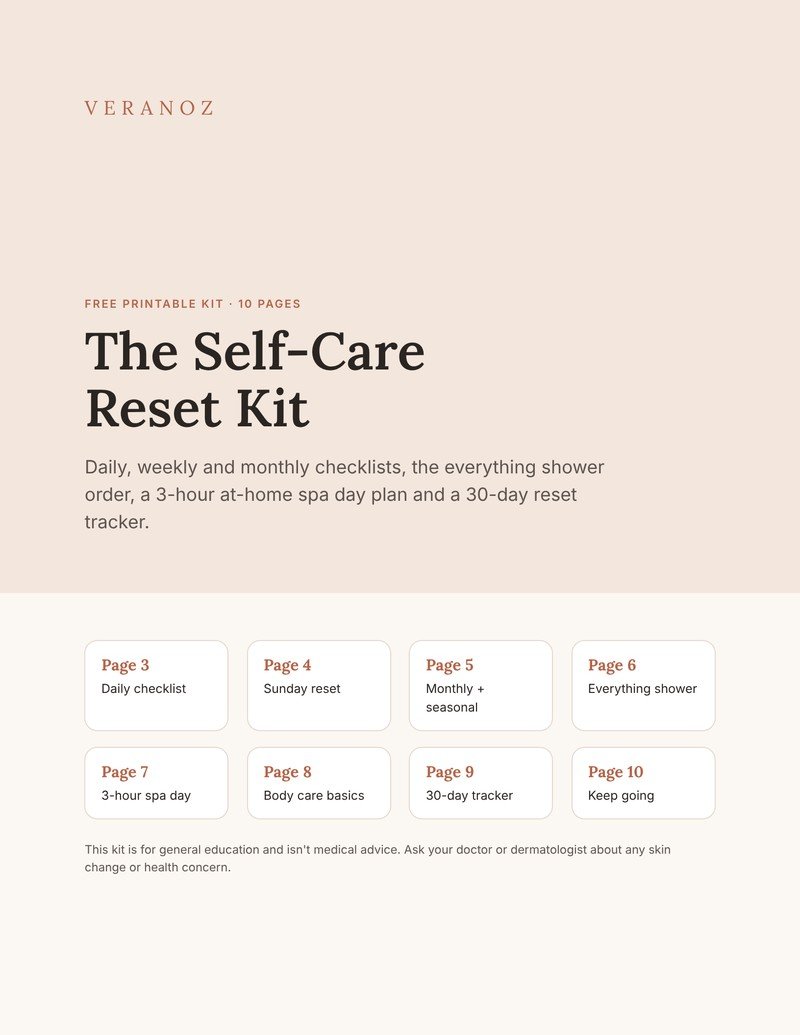
The Self-Care Reset Kit
Daily, weekly and monthly self-care checklists, the everything shower order, a 3-hour at-home spa day plan and a 30-day reset tracker.
Send me the free kit →In This Guide
- What a self care routine really is
- The six pillars of self care after 40
- How to build a self care routine in 6 steps
- Daily self care routine to copy
- Weekly and monthly self care
- 40+ self care routine ideas
- Sample routines for real lives
- Self care products that make it easier
- Common mistakes
- When self care isn’t enough
- Self care routine checklist
- FAQ
What a Self Care Routine Really Is
The National Institute of Mental Health describes self care as taking the time to do things that help you live well and improve both your physical and mental health. That definition is useful because it’s practical. Self care is not a reward you earn after everything else is done, and it’s not only bubble baths and face masks. It’s the ordinary maintenance that keeps you rested, steady and able to handle a demanding life.
A self care routine is simply those things on a schedule. The schedule matters. When self care depends on having a free evening or the right mood, it rarely happens. When it’s tied to fixed points in your day, like waking up, lunch, the commute home or brushing your teeth, it happens almost on autopilot.
After 40, the routine also has to fit a different stage of life. Many women are juggling careers at their busiest, teenagers or adult children, aging parents, or all three. Skin is drier and slower to recover than it was at 25, and sleep can be more fragile. That’s not a reason for a longer routine. It’s a reason for a smarter one: fewer steps, chosen on purpose.
If the word “self care” feels indulgent, call it maintenance. You service your car and charge your phone without guilt. Your routine is the same idea, applied to the person who runs everything else.
The Six Pillars of Self Care After 40
Almost every useful self care habit falls into one of six areas. You don’t need all six on day one. Use this table to see where you’re strong and where one small change would make the biggest difference.
| Pillar | What the evidence suggests | Small starting habit |
|---|---|---|
| Sleep | The CDC recommends 7 or more hours for adults 18 to 60, and 7 to 9 hours for ages 61 to 64, with the same bedtime and wake time every day | Set a “lights out” alarm and keep your wake time steady, weekends included |
| Movement | U.S. guidelines call for 150 to 300 minutes of moderate activity a week plus muscle strengthening on 2 or more days; older adults add balance work | A 10-minute walk after one meal a day |
| Nourishment | NIMH suggests regular, balanced meals and enough water, and noticing how caffeine and alcohol affect your mood | A glass of water with breakfast and a real lunch away from your desk |
| Calm | Mayo Clinic describes breathing, progressive muscle relaxation and visualization as skills that get easier with practice | Two minutes of slow breathing before you open email |
| Connection | The CDC links strong social connection to better stress management, better sleep and lower risk of several chronic diseases | One message or call to a friend each day |
| Skin and body care | The AAD recommends gentle cleansing, daily moisturizer and broad-spectrum SPF 30+ | Cleanse, moisturize and apply sunscreen every morning |
Notice how unglamorous most of these are. That’s the point. The habits with the strongest evidence are the boring ones, and they also happen to be the ones that make you look and feel better. Researchers at Karolinska Institutet found that faces photographed after sleep deprivation were rated as less healthy, more tired and less attractive than the same faces after normal sleep, which is a good reminder that sleep is a beauty habit too.
How to Build a Self Care Routine in 6 Steps
Step 1: Do a quick, honest audit
Spend ten minutes with a notebook and answer five questions:
- When in the day do I feel most drained?
- Which pillar above am I neglecting most?
- How many minutes do I realistically have in the morning, at midday and in the evening?
- What has made me feel good in the past, even briefly?
- What drains me that I could do less of?
The last question matters as much as the others. Self care is sometimes adding a habit and sometimes removing a drain: one fewer commitment, one less hour of scrolling, one boundary with a person who always takes more than they give. NIMH lists setting priorities and saying no to new tasks when you’re overloaded as part of self care.
Step 2: Choose three anchors
From your audit, choose three habits, ideally from different pillars. For example: a steady bedtime (sleep), a 15-minute walk (movement), and a morning skin care routine (skin). These are your anchors, the things you do even on bad days. Three is enough. Adding ten new habits at once is the fastest way to abandon all of them.
Step 3: Attach each anchor to a cue
Habits form when the same behavior is repeated in the same situation. In a well-known study by Phillippa Lally and colleagues at University College London, people chose one new daily health behavior tied to a daily cue, such as “after morning coffee.” On average it took 66 days for the behavior to reach peak automaticity, with a range from 18 days to an estimated 254 days. Two encouraging details: a single missed day made little difference, and simpler behaviors became automatic faster than harder ones.
So write each anchor as a sentence: “After I [existing habit], I will [new habit].”
- After I brush my teeth at night, I will put my phone on the charger outside the bedroom.
- After I finish lunch, I will walk for 10 minutes.
- After I wash my face in the morning, I will apply moisturizer and SPF.
Step 4: Write a full version and a two-minute version
Every anchor needs a version for good days and a version for terrible days. The terrible-day version keeps the habit alive, which is what matters for long-term consistency.
| Anchor | Full version | Two-minute version |
|---|---|---|
| Movement | 30-minute brisk walk | Walk to the end of the street and back |
| Calm | 10-minute guided relaxation | Five slow breaths before getting out of the car |
| Skin care | Cleanse, serum, moisturizer, SPF | Moisturizer with SPF |
| Connection | Coffee with a friend | A voice note saying “thinking of you” |
| Sleep | Wind-down hour with no screens | Phone out of the bedroom |
| Journaling | A page of reflection | One line: “Today I’m glad that…” |
Step 5: Design your space
Make the self care choice the easy choice. Put walking shoes by the door. Keep your skin care on the counter in the order you use it. Leave a water bottle on your desk. Charge your phone in the kitchen. Put a book on your pillow. Small changes to your environment do a lot of the work that willpower can’t.
If your bathroom counter is chaos, our guide to bathroom beauty organization that actually lasts will help you set it up so your routine takes less effort.
Step 6: Review after two weeks
Put a reminder in your calendar for two weeks from today. Ask what feels easy (keep it), what feels forced (shrink it or swap it), and what’s missing (add one thing, not five). Then review again every month. Your routine should change with seasons, schedules and energy levels.
Related ReadHow to Build a Beauty Routine That SticksDaily Self Care Routine to Copy
Here’s a daily self care routine in two sizes. Use the 10-minute column on busy days and the 30-minute column when you have more time. Both count.
| Time | 10-minute version | 30-minute version |
|---|---|---|
| Morning | Glass of water, cleanse or rinse, moisturizer with SPF 30+ | Water, 10 minutes of stretching or a short walk outside, full skin care routine, a few lines in a journal |
| Midday | Eat lunch away from your screen; two minutes of slow breathing | Lunch away from your desk plus a 15-minute walk |
| After work | Change clothes as a “the workday is over” signal | Strength or balance exercises, or a call with a friend |
| Evening | Remove makeup, cleanse, moisturize, phone on the charger outside the bedroom | Warm shower, full night skin care, 10 minutes of reading or progressive muscle relaxation |
| Bedtime | Same lights-out time as yesterday | Same lights-out time; dark, cool, quiet room |
The CDC’s sleep habits fit neatly into the evening part: a consistent schedule, a dark, calm and cool bedroom, devices put away at least half an hour before bed, and no large meals, alcohol or late caffeine close to bedtime.
For the skin care pieces, the AAD’s basic advice is simple: wash your face when you wake up, before bed and after heavy sweating, using a gentle cleanser, your fingertips and lukewarm water, then pat dry. Apply a broad-spectrum, water-resistant sunscreen with SPF 30 or higher every morning. If you want step-by-step skin routines, our morning routine ideas guide covers mornings and evening self care routine ideas covers nights.
If you’re using a retinoid at night, keep it to two or three nights a week at first and moisturize well; skin over 40 often gets dry and irritated if you rush it. Skip retinoids if pregnant, trying to conceive or breastfeeding. Our retinol after 40 beginner routine explains how to start.
Weekly and Monthly Self Care
Daily habits keep you steady. Weekly and monthly rituals are where you catch up, reset and look forward. Pick one from each row rather than all of them.
| How often | Self care ideas |
|---|---|
| Weekly (30 to 90 minutes) | A Sunday reset: plan meals, look at the calendar, change the sheets, do a face mask, paint your nails, take a longer bath or shower |
| Weekly (social) | A standing walk, coffee or phone call with one friend |
| Weekly (joy) | One hour of a hobby with no goal: gardening, painting, baking, music, a class |
| Monthly | Review your routine; book appointments; clear out expired products; one small “upgrade” such as a new pillowcase or a better water bottle |
| Monthly (gratitude) | Write a thank-you note to someone who made a difference to you |
| Yearly | Preventive care visits, a full-body skin check with a dermatologist, eye and dental checkups |
The gratitude note isn’t just a nice idea. Harvard Health summarizes research where people who wrote weekly about things they were grateful for became more optimistic and felt better about their lives, and where writing and delivering a gratitude letter produced a large, immediate boost in happiness scores. Harvard suggests aiming for about one thank-you note a month.
For a full weekly ritual, see our self care Sunday routine, our weekly beauty reset, or plan a full at-home spa day once a month.
40+ Self Care Routine Ideas
Use these self care routine ideas to fill in your anchors, swap things out when you get bored, or choose your weekly extra. Most take less than 15 minutes.
Body
- Walk outside for 10 minutes after a meal.
- Do five minutes of stretching while the coffee brews.
- Try two strength sessions a week with resistance bands or light dumbbells.
- Practice standing on one foot while you brush your teeth for balance.
- Take a yoga or tai chi class.
- Drink a glass of water before each meal.
- Pack a real lunch the night before.
- Stand up and move for two minutes every hour at your desk.
- Go to bed at the same time for a full week.
- Take a warm, short shower instead of a long hot one, and moisturize right after.
Mind and calm
- Two minutes of slow breathing before you check your phone.
- Progressive muscle relaxation in bed: tense each muscle group for about five seconds, release for 30.
- Write three things that went well today.
- Do a five-minute “brain dump” of everything on your mind before bed.
- Pick your top three tasks for tomorrow, and accept that the rest can wait.
- Say no to one thing this week.
- Turn off non-essential notifications.
- Read ten pages of a novel.
- Sit outside without your phone for ten minutes.
- Listen to a full album with your eyes closed.
Skin and beauty
- Cleanse, moisturize and apply SPF every morning, including your neck and the backs of your hands.
- Always remove makeup before bed.
- Do a hydrating face mask once a week.
- Give yourself a hand massage with a rich cream.
- Do a slow, gentle face massage while applying moisturizer.
- Exfoliate your body gently once a week.
- Do an at-home manicure or file and buff your nails.
- Use a deep conditioner or hair mask on wash day.
- Switch to a silk or satin pillowcase if your hair tangles.
- Clear out expired makeup and skin care.
Connection and joy
- Call a friend while you walk.
- Write a thank-you note.
- Plan a monthly dinner with friends.
- Join a class, choir, book club or walking group.
- Spend one hour on a hobby just for fun.
- Cook a recipe you’ve been saving.
- Buy yourself flowers.
- Have a no-plans Saturday morning.
- Volunteer for something you care about.
- Plan a day trip.
Home and boundaries
- Make your bed every morning.
- Do a 10-minute tidy before bed so you wake up to a calm space.
- Set a work cutoff time and stick to it.
- Create a cozy corner with a chair, a lamp and a blanket.
- Keep one evening a week completely unscheduled.
If you want even more, our simple self care ideas for your night routine and simple self care routine at home are full of easy options.
Free: the Winter Dry Skin Rescue Plan
A printable 14-day plan for dry, tight winter skin: shower rules, a face routine, and fixes for hands, lips and heels.
Free. You will also get a few short emails with tips and offers. Unsubscribe anytime. Privacy policy.
Sample Self Care Routines for Real Lives
The busy working woman
- Morning (10 min): water, quick skin care with SPF, five minutes of stretching.
- Midday: lunch away from the screen, 15-minute walk.
- Evening: hard stop on work email at a set time, phone out of the bedroom, same bedtime.
- Weekly: Sunday reset and one call with a friend.
The caregiver
- Morning: five quiet minutes with coffee before anyone else needs you.
- During the day: two-minute breathing breaks; ask one person for specific help each week.
- Evening: warm shower and night skin care as a signal that your shift is over.
- Weekly: one hour that is only yours, scheduled like an appointment.
The empty nester or newly retired
- Morning: walk outside, then a full skin care routine.
- Daily: strength or balance practice; a hobby or class with other people.
- Weekly: volunteer, join a group, or plan a standing lunch with friends.
- Monthly: try one new thing, from a recipe to a day trip.
The low-energy day
- Water, moisturizer with SPF, a short walk or stretch, a real meal, one message to a friend, bed on time.
- That’s it. On a low-energy day, doing the two-minute version of each anchor is a win.
Self Care Products That Make It Easier
You don’t need to buy anything to start a self care routine. These are product types that remove friction for the habits above; choose what fits your routine and skip the rest.
Guided Journal or Daily Planner
A simple daily page with space for your top three tasks, a habit tracker and one line of gratitude covers several self care habits at once.
Check on Amazon →Contoured Sleep Mask
A dark room is one of the CDC’s healthy sleep habits. A contoured mask blocks light without pressing on your eyes or lashes.
Check on Amazon →Resistance Band Set
Light, inexpensive and easy to keep by the TV, bands make it easier to fit muscle-strengthening into a busy week.
Check on Amazon →Large Reusable Water Bottle
Mayo Clinic notes that pale yellow urine and not often feeling thirsty are signs you’re drinking enough. A bottle on your desk makes it easier.
Check on Amazon →Gentle Cleanser and Daily Moisturizer With SPF
A fragrance-free cleanser and a moisturizer with broad-spectrum SPF 30+ cover your minimum morning skin care in one step. See our picks for the best sunscreen for women over 40.
Check on Amazon →Soft Robe and Bath Essentials
A soft robe, a body scrub for weekly use and a rich body cream turn an ordinary shower into a weekly ritual. Our everything shower routine walks you through it.
Check on Amazon →Common Self Care Routine Mistakes
- Starting with ten habits. Start with three. Add one at a time.
- Copying someone else’s routine. A 5 a.m. routine is useless if you’re a night person with a late shift.
- No minimum version. Without a two-minute option, one bad day becomes a lost week.
- Treating a missed day as failure. The habit research suggests one missed day barely matters. Just do the next one.
- Making it all about buying things. Products can help, but sleep, movement, connection and calm cost nothing.
- Using self care to avoid problems. A bath won’t fix a schedule that’s genuinely too full. Sometimes self care is a hard conversation or a cancelled commitment.
- Never reviewing. A routine that worked in summer may not fit winter. Check in every month.
When Self Care Isn’t Enough
A self care routine supports your health, but it isn’t a treatment for depression, anxiety or other conditions. NIMH recommends seeking professional help if severe or distressing symptoms last two weeks or more, such as trouble sleeping, changes in appetite, difficulty getting out of bed because of your mood, trouble concentrating, losing interest in things you usually enjoy, or being unable to do your usual daily tasks. Start with your primary care provider, who can refer you to a mental health professional.
If you or someone you know is in crisis or thinking about suicide, call or text 988 in the U.S. to reach the 988 Suicide and Crisis Lifeline, available 24/7. In an emergency, call 911.
The same goes for skin: if your skin stings with every product, a rash won’t settle, or a spot changes, bleeds or itches, see a board-certified dermatologist rather than adding another product.
Self Care Routine Checklist
Daily Anchors
- Same wake time and lights-out time
- Water with breakfast; regular meals
- Some movement, even 10 minutes
- Two minutes of slow breathing or quiet
- Cleanse, moisturize and SPF 30+ in the morning; cleanse and moisturize at night
- One message or call to someone you like
- Phone out of the bedroom
Weekly
- A reset: calendar, meals, clean sheets
- Strength exercises on two days
- One hour of a hobby for fun
- One social plan
- One beauty ritual: mask, manicure or hair treatment
Monthly
- Review your routine: keep, shrink, swap or add
- Write one thank-you note
- Clear out expired products
- Book any appointments you’ve been putting off
Frequently Asked Questions
What should a self care routine include?
A good self care routine covers six areas: sleep, movement, nourishment, calm, connection, and skin and body care. Start with three small habits from different areas and add more once those feel automatic.
How do I start a self care routine when I have no time?
Use two-minute versions: moisturizer with SPF in the morning, five slow breaths in the car, a walk around the block after lunch, phone out of the bedroom at night. Attach each to something you already do so you don’t have to remember it.
What is a good daily self care routine?
Morning: water, gentle skin care with SPF and a little movement. Midday: a real lunch away from your screen and a short walk. Evening: a work cutoff time, night skin care, screens away at least 30 minutes before bed, and the same bedtime every night.
How long does it take to make self care a habit?
It varies. In one well-known study, it took an average of 66 days for a daily habit to feel automatic, with a range from 18 days to much longer. Missing one day didn’t make much difference, so keep going.
What are some easy self care routine ideas?
Walk after meals, stretch while the coffee brews, write three good things before bed, take a short warm shower and moisturize right after, call a friend, read ten pages of a novel, and keep one evening a week unscheduled.
Is self care selfish?
No. Rest, movement, good food and connection help you handle stress and show up for the people who rely on you. Think of it as maintenance, not indulgence.
When should I get help instead of relying on self care?
If low mood, anxiety, sleep problems or loss of interest last two weeks or more, or make daily life hard, talk to your doctor. In a crisis in the U.S., call or text 988.
Sources: National Institute of Mental Health, Caring for your mental health; Centers for Disease Control and Prevention, About sleep and About social connectedness; U.S. Department of Health and Human Services, Physical Activity Guidelines for Americans, executive summary; Mayo Clinic, Relaxation techniques: Try these steps to lower stress and Water: How much should you drink every day?; Harvard Health Publishing, Giving thanks can make you happier; American Academy of Dermatology, 10 skin care tips dermatologists use; British Psychological Society Research Digest, How to form a habit (on Lally et al., 2010); Karolinska Institutet, A good night’s sleep the key to being attractive (on Axelsson et al., BMJ 2010). This guide is general information, not medical advice.
Get the Free Self-Care Reset Kit
Daily, weekly and monthly self-care checklists, the everything shower order, a 3-hour at-home spa day plan and a 30-day reset tracker. Free printable, instant access.
The Veranoz 30-Day Glow-Up Planner
Routines only work when you actually keep them. The planner gives you daily planning pages, weekly resets and habit trackers so your skincare, body care and self-care steps become automatic instead of something you remember once in a while.
Veranoz Guides to Go Deeper
Some links on Veranoz are affiliate links; we may earn a commission at no extra cost to you. This content is informational and not medical advice.